



On 16 September 1993, in the fifth game of their match in London, Kasparov and Short played a Nimzo-Indian and agreed a draw after 18 moves. The game ended with 18.O-O. Lubomír Ftáčnik’s notes for ChessBase Magazine, dated the following month, carried the position on: 18...Rxc5 19.Qe4 Bxc3 20.bxc3 b6 21.f4 Qxc3, which he assessed as level; Stockfish at depth 42 gives 0.00 there. The match finished on 21 October. On 30 November the semifinals of the 20th ICCF World Championship began by post, and in one of them, Hőgye–Yeremenko, the first 18 moves of game 5 were played again, move for move. The game then went on along Ftáčnik’s line, 18...Rxc5 19.Qe4 Bxc3 20.bxc3, before leaving it with 20...Qc7. It was drawn on move 43, some time in a section that ran until the end of 1997. The study doesn’t count it: the archive dates it only to 1993, too coarse to place it after the match, and by the study’s book game 5 left over-the-board theory only with its final move, so there was nothing further to follow.
Even so, that game is the shape of what I found when I put every classical world championship game since 1886 against the correspondence archive. The usual story runs the other way: correspondence, with engines and unlimited time, is supposed to be where theory is made, and the title match where it is used. Measured, the archive is there first for about one elite departure from over-the-board theory in six since 2010, usually as a single game a move deep, and world championship games are no more likely to land on it than the same players’ other games. What sets the world championship apart comes afterwards. Correspondence games started in the two years after a world championship game take up its line more than twice as often as they take up the same players’ other games, and more often play its move.
What I measured
For every game in the 50 world championship matches from Steinitz–Zukertort to Ding–Gukesh, 974 classical games, I found the point where it left over-the-board theory (five never did: they ended inside it): the first move that produced a position no earlier game in ChessBase’s Mega Database had reached. Then I asked two questions of the correspondence archive, Opening Master’s OM CORR in its September 2026 release, 2.35 million games.
The first is whether a correspondence game had already reached that position. A correspondence game counts only if it started at least two years before the title-match game. Records carry a start date and no finish date. In the one archive release that allows a check, 95% of games were in the archive within 20 months of starting; postal games ran longer, so for the postal era the rule still lets in some games that got there after the title-match game. The second is whether a correspondence game started within the next two years reached the same position, whenever it got there, and continued along the title-match game’s moves for at least two more half-moves. That is what “follows” means throughout this piece.
Neither question means much on its own, so the comparison is with the same players’ other classical games within two years of each match, 12,400 of them, matched on era and, for the second question, on how many correspondence games had already passed through the last position still in book. Positions are compared, not move orders, so a transposition counts.
What the archive already holds
The first chart answers the first question by era, for the world championship games, the same players’ other games, and games between two players rated 2700 or more by FIDE.
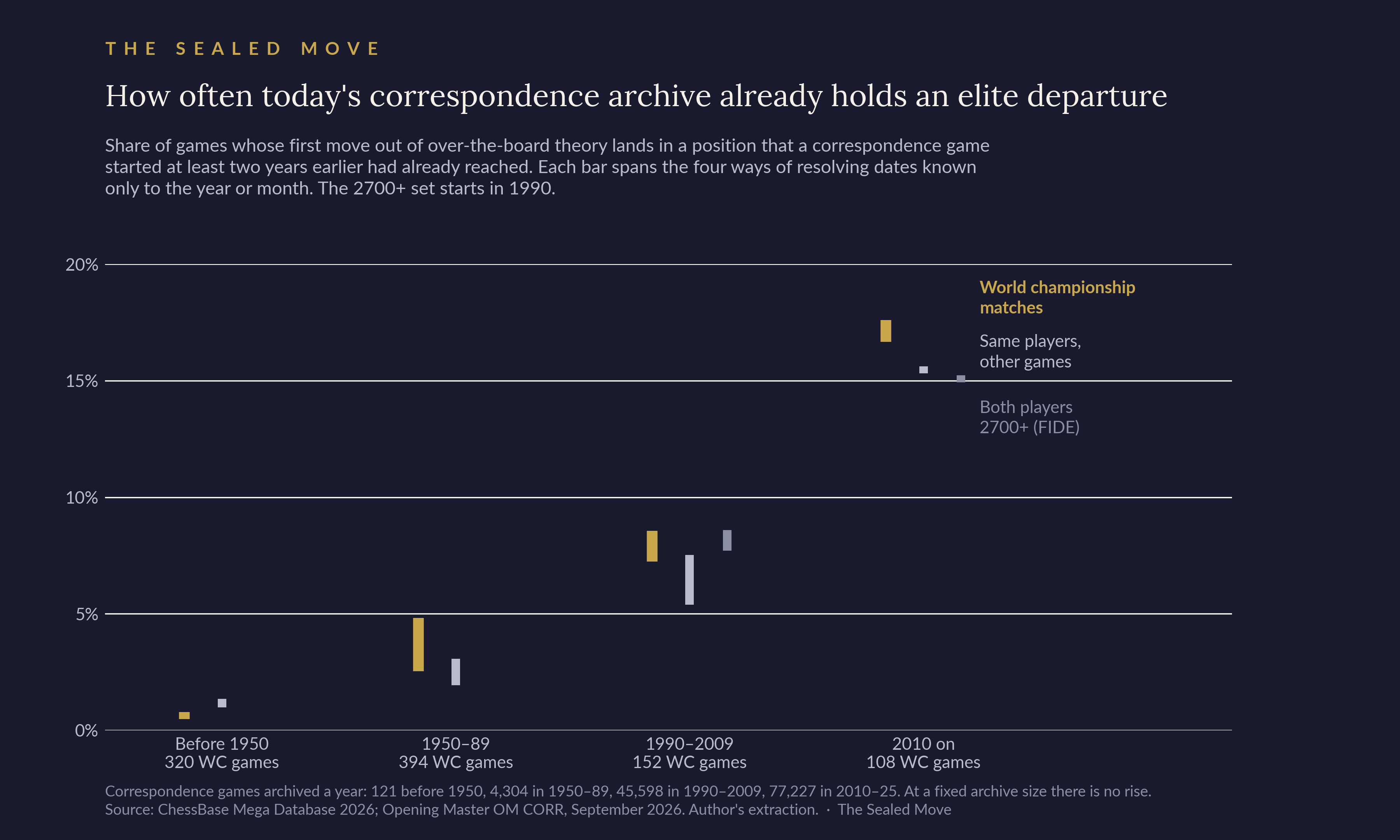
Since 2010, a correspondence game started at least two years earlier was already at the departure position in about 17% of world championship games (108 games in nine matches, so the interval is wide, roughly 9% to 25%) and in about 15% of the comparison games. Before 1950 it was under 1%. All three groups move together.
The chart is a picture of the archive, and the archive has grown enormously. OM CORR holds about 120 games a year from before 1950 and over 77,000 a year since 2010. When I held the archive at a fixed size per year and ran the same test again, the rise disappeared: at 1,000 games a year the share for world championship games since 2010 falls from 16.7% to 1.3%, and the comparison games fall the same way. Thinning changes which openings and players are represented as well as how many games there are, so I won’t say the whole rise is archive size. I will say the chart can’t be read as correspondence getting further ahead.
Nor is “already there” a body of theory. Of the world championship departures the archive holds, three in four had exactly one correspondence game behind them, and only 6% had seen correspondence try more than one continuation from the position. The comparison games sit on slightly thicker ground (65% single games, 17% with more than one continuation).
In the toolkit piece I wrote that “Correspondence games, played with engines and virtually unlimited thinking time, frequently establish theory months or years before it appears in OTB play.” Measured against the elite departures from theory, that was too strong. Today’s archive holds about one in six of them, and usually as one game that had played the same move.
Nothing special beforehand
If world championship teams leaned on correspondence more than their players do in ordinary events, title-match games should land on the correspondence archive more often than those players’ other games. They don’t, detectably.
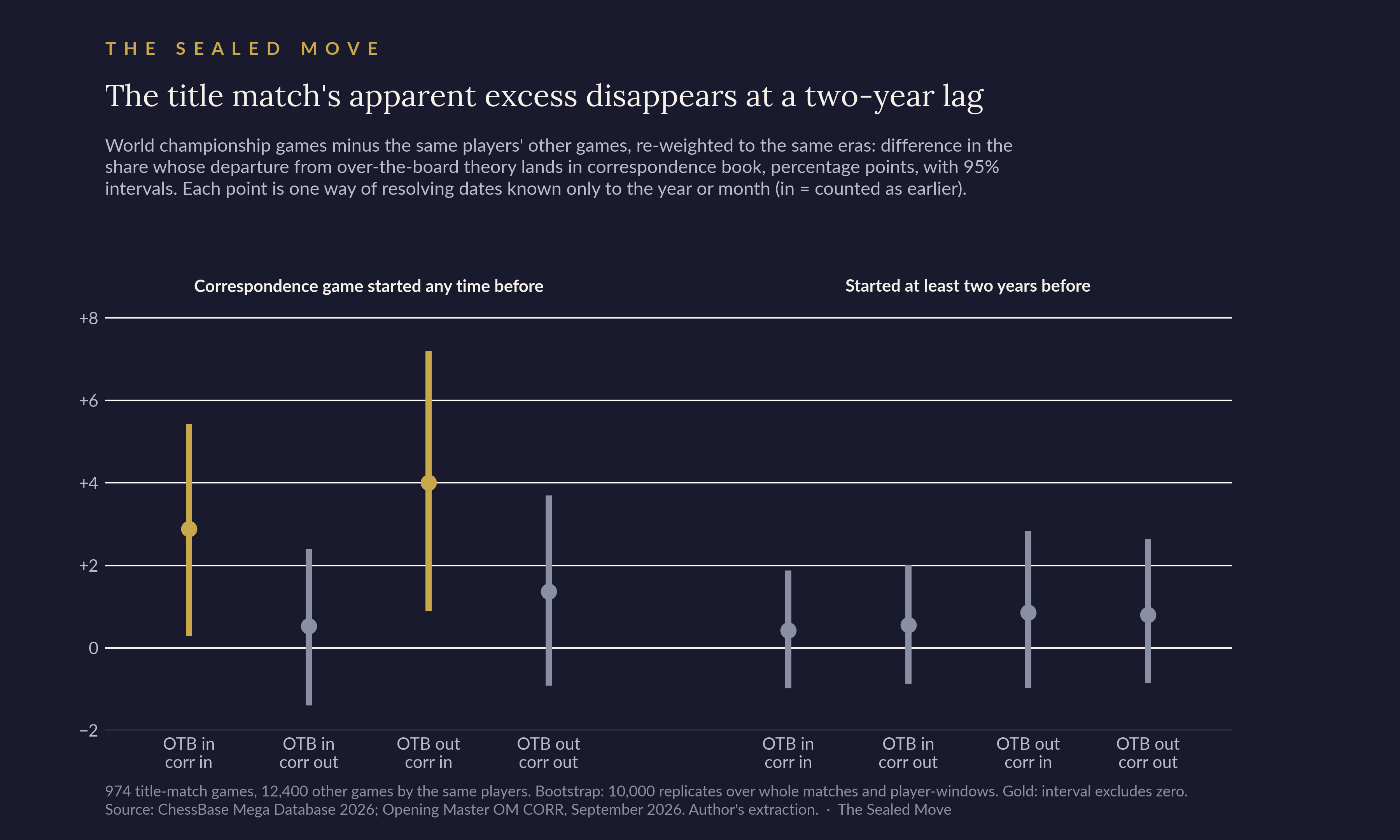
With the two-year rule, the world championship excess over the same players’ other games is between 0.4 and 0.9 percentage points, depending on how dates known only to the year are resolved, and every interval includes zero. The data rule out an excess larger than about 2 to 2.5 points. The chart also shows why the two-year rule matters. Count any correspondence game that started before the title-match game, however shortly, and treat year-only dates as earlier, and an excess of three or four points appears. It vanishes once the correspondence game has to be two years older. The games that produce it started in the two years before the title-match game, and the archive can’t say whether they reached the position before or after it.
The opponents don’t explain it either. A title-match game is played between two elite players, and many of the same players’ other games are not. Games between two players rated 2700 or more by FIDE, the third line in the first chart, sit where the world championship games do: 7.7 to 8.6% against 7.2 to 8.6% in 1990–2009, and 15% against 17% since 2010, inside the world championship interval.
Two limits on what this shows. It measures overlap of positions. If a team consulted correspondence and the game then stayed in book, or produced a move nobody had played, this test can’t see it. And a reader who pools all the eras will find world championship games below the comparison set; that is because a third of them were played before 1950, when the archive is nearly empty.
A move deep
When the archive does hold the position, it rarely holds much beyond it. The correspondence game shares on average about three half-moves with the title-match game from the departure point, and the median is two: the same departure move, and one more. In no world championship game did the shared stretch run to four half-moves through positions where correspondence had tried more than one move.
Game 10 of Carlsen–Anand in Sochi, 21 November 2014, is the typical case. Anand had White, and the game left over-the-board theory with 14...Ne4. One correspondence game had been there: Heinsohn–Cerrato, from the ICCF Champions League event CL/2012/B4, which started on 15 October 2012. It had reached the position by another route. Carlsen played 11...Re8 and 13...Bf5; Cerrato had played 11...Bf5 and 13...Re8. Both games then went 14.Rad1 Ne4 15.Nxe4, and there they parted. Carlsen took with the bishop, 15...Bxe4. Cerrato had taken with the rook, 15...Rxe4 16.Qc1, the line Michał Krasenkow gave as the alternative in his notes to game 10 for ChessBase Magazine. Stockfish, at depth 35, prefers the rook: 15...Rxe4 at +0.02, against +0.48 for 15...Bxe4. After 16.Qc1 the engine keeps only 16...Nb4 near equality, at +0.03 against +0.78 for the next best, and Cerrato played it. The correspondence game was drawn, and ICCF lists its result before the event’s latest results, which are dated 26 August 2014.
The long cases exist, and they are the tail. In the first Karpov–Kasparov match, the game of 8 October 1984 stayed inside a correspondence game started in 1969 (Packroff–Schreyer) for 14 half-moves, reached by transposition, and ended there. Anand–Kasparov, 28 September 1995, followed a 1990 correspondence game (Zastrow–Lehmitz) for ten. Both are long because there was only one road through those positions.
After the match
The second question is where the world championship stands out.
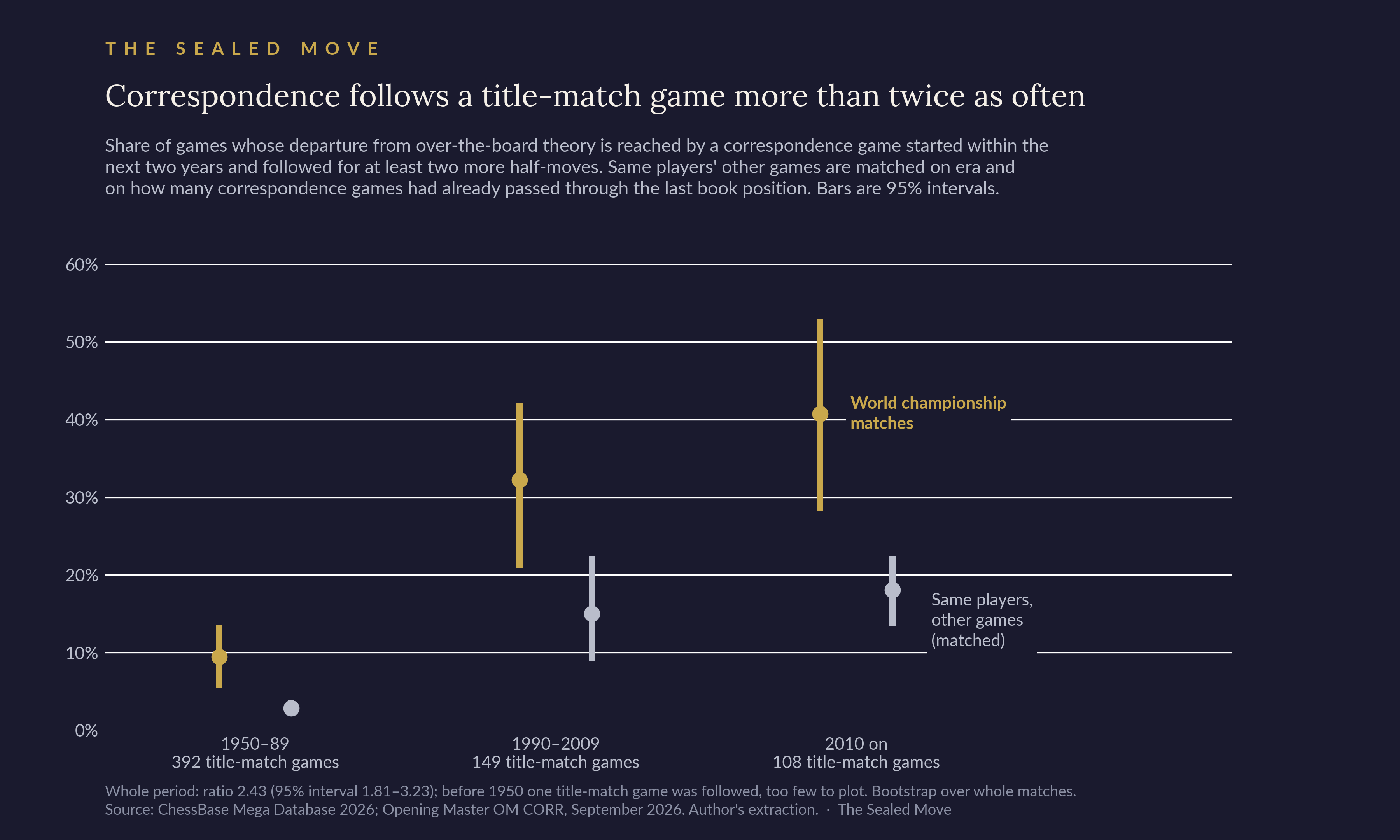
Matched on era and on how busy the position already was in correspondence, world championship games are followed by correspondence games started within two years about 2.4 times as often as the same players’ other games: 2.43, with a 95% interval of 1.81 to 3.23. The ratio is 3.3 in 1950–89, 2.1 in 1990–2009 and 2.3 since 2010, and every era’s interval excludes 1. Since 2010, 41% of world championship games have their departure position taken up and followed by a correspondence game started within two years, against 18% for the matched comparison games.
Put the two questions side by side on the same departure positions and the asymmetry is plain. Whether a game is a world championship game makes no detectable difference to whether correspondence got there first (ratio 1.12, interval 0.81 to 1.47). It makes a large difference to whether correspondence follows. Estimated together on the same bootstrap replicates, the follow ratio is about twice the precede ratio: 2.16, with an interval of 1.52 to 3.14. The two windows aren’t mirror images, and the notes give the exact definitions, but all 10,000 bootstrap replicates put the figure above 1.
Correspondence also plays the title-match move more often. Where later correspondence games reached the position just before the title-match game’s departure move, which happened for 260 world championship departures, they played that move 52.5% of the time on average, against 36.9% for comparable games (ratio 1.42, interval 1.26 to 1.61).
The same holds outside matches. The FIDE knockout world championships of 1997 to 2004, set against their own players’ other games, give 2.35 (1.93 to 2.81). The world championship tournaments of 1948 and 2007 give 1.87 (1.31 to 2.54), on thinner data; the 2005 tournament on its own is too thin to read (1.31, 0.63 to 2.23). Whatever draws correspondence to these games, it isn’t the match format.
The result holds under every check I could think of. It survives restricting the title-match games to those with at least four years of follow-up before the archive was frozen, dropping each rivalry in turn (2.19 to 2.61), dropping each post-2010 match in turn, dropping each opening family, counting each branch once, and it is the same with or without the records that are not correspondence play: cable and radio matches, online live play, and records that copy an over-the-board game move for move.
Kaden–Krivonosovs is one of the games behind those numbers. Game 3 of Kasparov–Kramnik, London, 12 October 2000, was drawn after 53 moves; by this study’s book it left over-the-board theory at 13.Ne2. A section of the European Championship semifinals began by post on 31 December 2000, and in Kaden–Krivonosovs the title-match game was taken up at that point and followed to 19.Nh5. There Kramnik had played 19...Rg6; the correspondence game chose 19...Ng6. ICCF records the game as a win for Krivonosovs.
Moscow, 2012
Moscow is the rare case that runs the other way. The first game of Anand–Gelfand, Moscow, 11 May 2012, left over-the-board theory with 13.Rb2, which Krasenkow’s notes for ChessBase Magazine mark as a novelty.
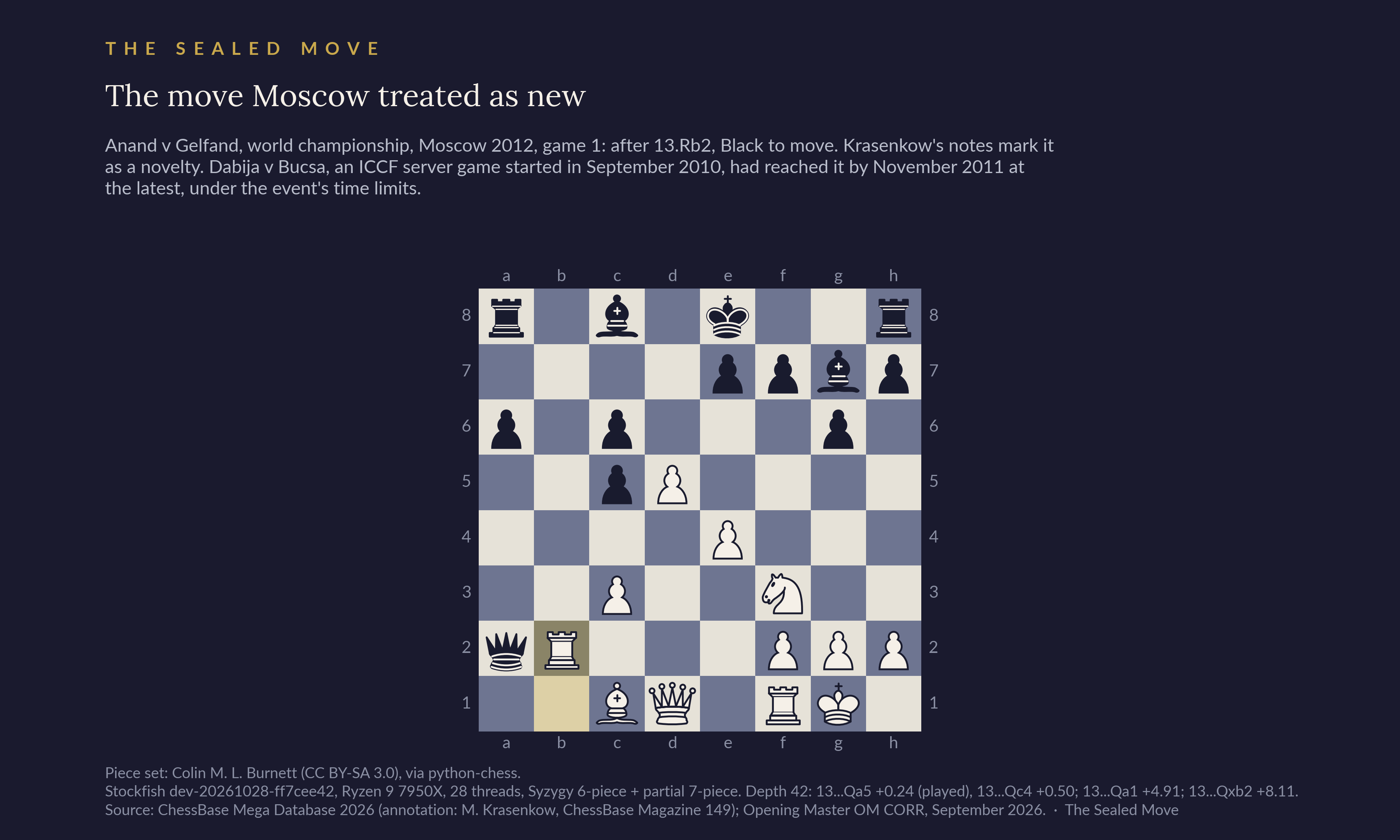
It was a sound one. Stockfish, at depth 42, gives 13...Qa5, which Gelfand played, as +0.24; 13...Qc4 as +0.50; 13...Qa1 as +4.91 and 13...Qxb2 as +8.11. Krasenkow’s notes recommend two improvements for White later in the game, and both had been played in correspondence games started before the match.
At move 15 he gives 15.Bf4 Rd7 16.Rd2. In Dabija–Bucsa, from the final of the 6th Romanian Internet Championship, an ICCF server event that started on 10 September 2010, the late IM Mircea Dabija had played 15.Bf4, and the game went 15...Rd7 16.Rd2 before leaving the line. ICCF’s server rules then in force allowed 50 days for every ten moves and 30 days of leave a year, and let the tournament director grant up to 30 more. If both players had used every day of their time and every day of both kinds of leave, 16.Rd2 was on the board by 24 November 2011, more than five months before Moscow. Only an extension of leave in exceptional circumstances, or a clock adjustment after a server outage, could move that date.
At move 20 Anand played 20.Rc2, which Krasenkow calls too passive, preferring 20.Ra2.
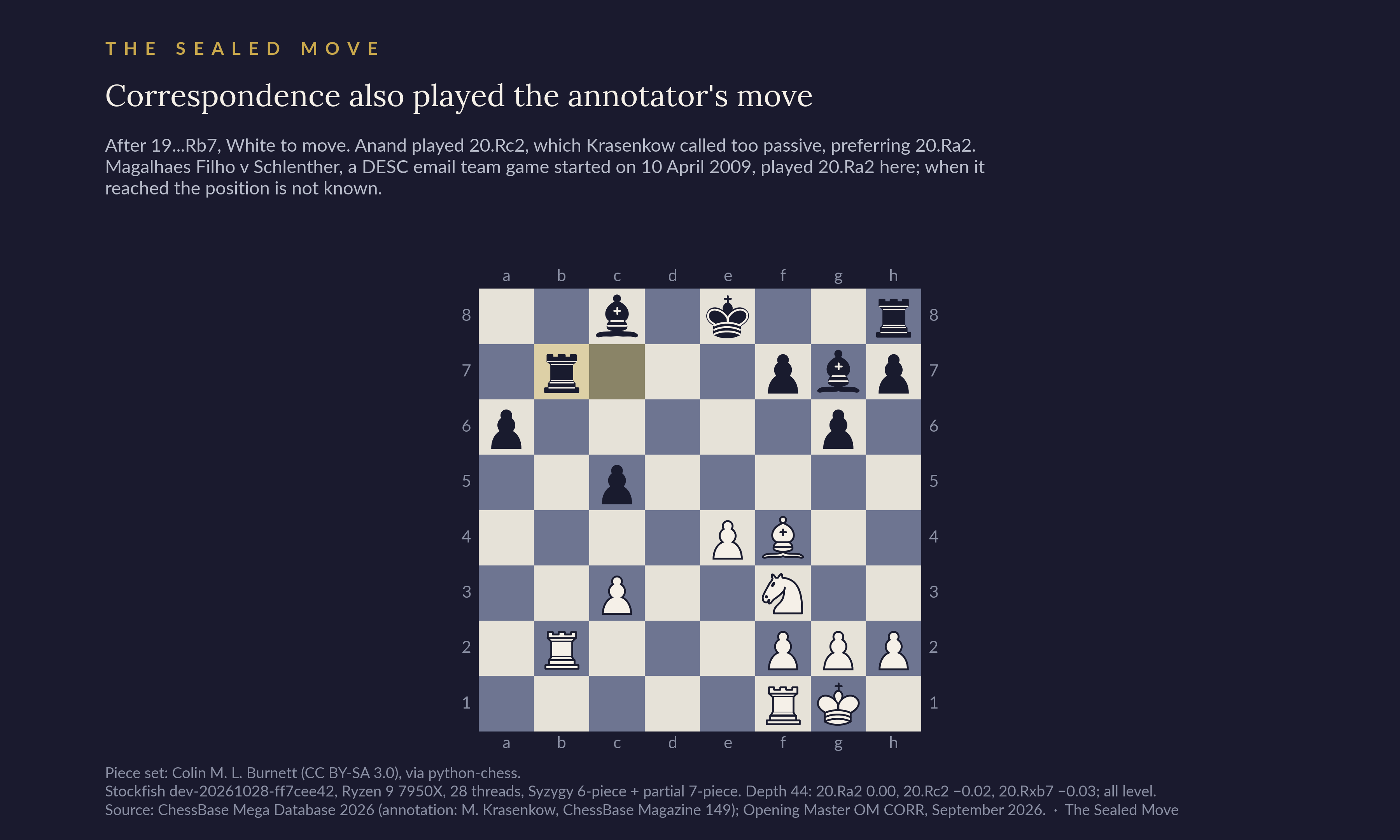
Magalhães Filho–Schlenther, an email game from a DESC team match that started on 10 April 2009, shares the first 38 half-moves with Moscow and then plays 20.Ra2. DESC’s archive is no longer online, so I can say when that game started and not when it reached move 20. At depth 44 the engine has 20.Ra2, 20.Rc2 and 20.Rxb7 all level.
Then the afterlife. In the correspondence archive, nine games with 13.Rb2 started after Moscow, from July 2012 to 2024, against two before it. One of them, Prokopenko–Chbib, from a Belarus–Germany match on the ICCF server that started on 15 December 2012, played 20.Ra2. In one line, then: correspondence was there first by one game for certain and perhaps two, and the crowd came after the world championship.
What the archive can’t answer
One explanation for the main result survives everything above, and the data can’t rule it out. World championship games might choose moves that correspondence was about to take up anyway: lines already rising through engines, publications and fashion, which the title match joins rather than leads. I tried to test it by comparing how often correspondence played the title-match move in the two years before each game and the two years after. Only 72 of the 969 departures have correspondence games at that position in both windows, and every interval for the change spans zero. So I can say that correspondence follows world championship games more than twice as often as their players’ other games, and plays their moves more often. I can’t say why.
The archive also can’t say anything about the years before 1950, when it holds about 120 games a year, and it can’t see whether a team looked at correspondence games and then stayed in book.
And it is a record of correspondence chess, not a census of it. Before the servers, much of what survives came through bulletins, magazines and private collections, and a game that took up a famous line may have had a better chance of being kept. That could be part of why the ratio is highest in 1950–89. It probably isn’t all of it: since 2010, when server events publish every finished game, the ratio is still 2.3, though I haven’t checked how completely the archive takes those games in.
On 30 November 1993 a postal semifinal began that would run until the end of 1997, and in one of its games an 18-move draw from London was played out again, carried on along a magazine’s notes, and drawn 25 moves later.
SIM Paweł Fiedor - The Sealed Move
Notes on method
The world championship set. Every classical game from two-player world championship matches in ChessBase Mega Database 2026 (PGN export, 11,845,409 games), identified by event name and checked against the published list of title matches (Lichess’s World Championships page; Wikipedia’s List of World Chess Championships for the 1993–2006 split): 50 matches from 1886 to 2024, 974 games after removing two records with no moves (the forfeits in 1972 and 2006). The rapid tiebreaks of those matches (19 games: 2006, 2012, 2016, 2018 and 2023) are excluded. Both lines of 1993–2006 are included. Two-player matches under other event names were checked and none is a title match; the 1872 Steinitz–Zukertort match, the 1909 Lasker–Janowski casual match, the 1992 Fischer–Spassky rematch, the 1937 Alekhine–Euwe exhibition games and Candidates matches are excluded, as are women’s title events. The world championship tournaments (1948, 2005, 2007) and the FIDE knockouts (1997/98–2004) are analysed separately. Mega files one game of the 1960 match under its own event name, so the bootstrap has 51 match clusters.
Departures. 969 of the 974 games have a departure. The other five are short games, 21 to 41 half-moves, that end with every position still in the over-the-board book: Kasparov–Karpov and Karpov–Kasparov, 1984, games 12 and 35; Timman–Karpov, 1993, game 11; Anand–Kasparov and Kasparov–Anand, 1995, games 15 and 18. Where two of them reach a position whose book status depends on how undated games are resolved, they gain a departure, giving 971; the figures in the text use 969.
Comparison sets. The same players’ other classical games within two years of each match (12,400; no game in it is a world championship game; a game falling in more than one player’s window is counted once and assigned to the nearest match). Games between two players rated 2700 or more from 1990 (11,515; FIDE ratings, from Mega’s Elo tags), compared only with world championship games from 1990.
The two books. Over-the-board: Mega 2026 without correspondence, engine, online, rapid, blitz, blindfold, simultaneous and Chess960 games (9,826,865). Correspondence: Opening Master OM CORR, September 2026 release (2,349,779 after deduplication), with cable, telegraph, radio and telephone matches, online live play (10,188 games) and records that are full copies of over-the-board games in Mega (17,185) removed. Each book is frozen at the date of the game being classified. Positions are compared by Polyglot key over the first 60 half-moves. No world championship game is cut off by that limit: departures fall between half-moves 5 and 52 (median 20), and the five games without one end in book before half-move 60.
Dates. Correspondence records carry a start date and no finish date. A correspondence game counts as having been there first only if it started at least two years before the over-the-board game. The two years come from the one OM release that allows a duration estimate (recorded as “Updates”, 2 November 2020: 40,097 games with a day-precise start, median 294 days from start to release, 95th percentile 597), which assumes games enter the archive only once finished. The measure is therefore what the archive held by start date, not the date a position was reached. Dates known only to the year or month are resolved both ways on each side and every share is given as a range. Undated correspondence games (3,479) are excluded; OM CORR dates on the 1st of a month are treated as month-only and those on 1 January as year-only, which can only lower the first-question shares.
The two questions. Precedes: a correspondence game started at least two years before the over-the-board game had reached its departure position. Follows: a correspondence game started within two years after the over-the-board game reached its departure position and continued along its moves for at least two more half-moves. The windows are not mirror images (the first has no lower limit). The joint contrast is estimated in each bootstrap replicate on the same set of games. The joint figure, 2.16, is the matched follow ratio (2.43) divided by the matched precede ratio (1.12, 0.81–1.47), both standardised to the world championship mix of era and prior traffic with the same weights; the point estimate is taken on the full sample and the interval from the same 10,000 replicates for both. Without the two-half-move continuation requirement the matched follow ratio is 2.22 (1.74–2.81) and the joint figure 1.97 (1.45–2.76).
Matching and uncertainty. The comparison games are re-weighted to the world championship era mix (before 1950, 1950–89, 1990–2009, 2010 on) and, for the second question, to its distribution of prior correspondence traffic through the last book position (0, 1–9, 10–99, 100–999, 1000+ games). Within era the two distributions are close. Intervals are 95% percentile intervals from 10,000 bootstrap replicates (seed 20261030) resampling whole matches and whole player-windows within era.
Move choice. The 52.5% and 36.9% are averages over title-match and comparison games of the share of later correspondence games that, having reached the position before the departure move, played the departure move: 260 world championship games and 2,881 comparison games, behind which are 1,529 and 23,204 game-position pairs. The window and dating rules are those of the second question; the comparison games are standardised to the world championship mix of era and prior traffic, and each is compared with its own departure move. Pooled over correspondence games instead of averaged over title-match games, the shares are 39.6% and 29.8%; standardised by era alone, the ratio is 1.48 (1.31–1.66). 10,000 replicates, seed 20261030, 42 and 49 clusters.
Checks on the second question. Contamination: removing cable, telegraph, radio and telephone matches and online live play (10,188 games) changes three title-match classifications (Lasker–Marshall 1907) and no successor result; removing the 17,185 records that copy an over-the-board game in Mega move for move changes no title-match classification and no title-match successor, and moves the era-only ratio from 2.48 to 2.50. The matched ratio is computed on the clean book. Follow-up: only the games since 2010 have short follow-up (13% of world championship games under two years before the freeze); restricted to games up to September 2022 the ratio is 2.46 (1.83–3.27), with the same result at 2020 and 2018; across the archive’s releases from September 2024 to September 2026 the ratio moves from 2.45 to 2.43. Dependence: 969 departures sit on 968 distinct branches; counting each branch once gives 2.43. Leave-one-out: rivalries 2.19–2.61; post-2010 matches 2.41–2.49; opening families 2.35–2.49. An alternative definition of prior traffic and a different banding give 2.26 to 2.48.
Thinning. Each start year’s correspondence games were capped at 5,000, 1,000 and 113 a year (20 replicates each) and the first question rerun. Since 2010 the world championship share falls from 16.7% to 3.1%, 1.3% and 0.1%.
Named games. Title-match games from Mega 2026. Correspondence games from OM CORR, checked against ChessBase Corr and against ICCF event pages for CL/2012/B4 (with the ICCF score), ROM/IC6/final, WC20/SF9 and EU/C64/sf07. ICCF holds results but no scores for the two postal events, and its records show the colours of Hőgye–Yeremenko and Kaden–Krivonosovs reversed relative to OM CORR and ChessBase Corr, which agree on the moves. The text names both games as those two databases do, White first, and doesn’t otherwise rely on who had which colour; no source available to me settles which record is wrong. Magalhães Filho–Schlenther’s score is from OM CORR alone (DESC’s archive is offline). Start dates are event start dates, from the ICCF event pages; OM CORR dates Hőgye–Yeremenko only to 1993, which is why the study can’t count it as following game 5; in postal and server events every game starts on that date. Annotations: L. Ftáčnik, ChessBase Magazine 036 (ChessBase source date 1 October 1993); M. Krasenkow, ChessBase Magazine 149 and 164. The tail games: Karpov–Kasparov 1984 (Mega M572566831) with Packroff–Schreyer, EU/M/229, started 1969; Anand–Kasparov 1995 (Mega M1488568673) with Zastrow–Lehmitz, cr M/1289E, started 1990; both reached by transposition. The games with 13.Rb2 after Moscow are from OM CORR (Date tag, start year). The Dabija–Bucsa bound uses the ICCF playing rules for server events adopted at Leeds in 2009 and in force from 1 January 2010: Art. 6(a), 50 days for every 10 moves; Art. 6(b), days beyond 20 on a single move charged double; Art. 7(a), 30 days’ leave per calendar year; Art. 7(c), up to 30 days’ additional leave a year at the tournament director’s discretion, ‘which in exceptional circumstances may be back-dated and/or extended’; Art. 10(b), clock adjustment after a server outage at the director’s decision. Reaching White’s 16th move takes each player at most 100 days of reflection, 200 in all. Ordinary and additional leave for both players across 2010 and 2011 add at most 240 days. 440 days from 10 September 2010 is 24 November 2011; the first game in Moscow was played on 11 May 2012. The double charge can only bring the date earlier.
Engine. Stockfish dev-20261028-ff7cee42, AMD Ryzen 9 7950X, 28 threads, 64,000 MB hash, Syzygy 6-piece and partial 7-piece tablebases. After 13.Rb2 (Anand–Gelfand; r1b1k2r/4ppbp/p1p3p1/2pP4/4P3/2P2N2/qR3PPP/2BQ1RK1 b kq - 1 13, diagram 1): depth 42. After 19...Rb7 (2b1k2r/1r3pbp/p5p1/2p5/4PB2/2P2N2/1R3PPP/5RK1 w k - 2 20, diagram 2): depth 44 (selective 47). Both diagrams are rendered from these FENs. After 20.bxc3 in Hőgye–Yeremenko (5rk1/pp3p2/7p/q1r3p1/4Q3/2P1PP2/P4P1P/R4RK1 b - - 0 20): depth 42, 20...b6 and 20...Qc7 both 0.00. After 21...Qxc3, the end of Ftáčnik’s line (5rk1/p4p2/1p5p/2r3p1/4QP2/2q1P3/P4P1P/R4RK1 w - - 0 22): depth 42, four lines, all 0.00 (22.Rac1, 22.Kh1, 22.fxg5, 22.Rad1). After 14...Ra7 in Anand–Gelfand (2b1k2r/r3ppbp/p1pP2p1/q1p5/4P3/2P2N2/1R3PPP/2BQ1RK1 w k - 1 15): depth 41, Krasenkow’s 15.Bf4 is the top line at +0.18, against 15.Bg5, played in Moscow, at −0.02; all four lines are within 0.25 of zero. Kaden–Krivonosovs’s final position: depth 39, −0.07. After 16.Rd2 in Krasenkow’s line (2b1k2r/3rppbp/p1pP2p1/q1p5/4PB2/2P2N2/3R1PPP/3Q1RK1 b k - 4 16): depth 40, 16...exd6 0.00, 16...Bxc3 +0.23, 16...O-O +0.67. Sochi, after 15.Nxe4 (r2qr1k1/pp3pb1/n5pp/2pP1b2/2Q1N3/4BN2/PP2BPPP/3R1RK1 b - - 0 15): depth 35, 15...Rxe4 +0.02, 15...Bxe4 +0.48; after 16.Qc1 (r2q2k1/pp3pb1/n5pp/2pP1b2/4r3/4BN2/PP2BPPP/2QR1RK1 b - - 1 16): depth 34, 16...Nb4 +0.03, next best 16...Qf6 +0.78. Sochi FENs by replay of Mega M7412136398 and of Heinsohn–Cerrato, which reaches the same position after 15.Nxe4 and plays 15...Rxe4 16.Qc1 16...Nb4.
Very interesting! But I do think that it might be excluding too many potential model games right now. I think that the assumption that only games that started two years prior count is likely to be problematic, particularly for modern engine era title matches. For example, in my database there are over 105,000 ICCF games played in 2025 and 2026 already in the database and close to 190,000 for 2024 on.
On the one hand I think it is underestimating ICCF model games that existed and on the other hand it is overestimating ICCF games that followed OTB model games. I think it would make sense that if the WC players and their teams looked at ICCF games, they would be looking at the most recent high-level games available. I think it is likely the assumption is discarding the games most likely to have been the ones that they actually referenced for modern (engine era) OTB title matches (the ones started most recently, within the two-year cutoff used in the analysis).
It would be interesting to get a report on how many games matched that were in that two-year period to better understand the scale of the issue. I think those would need to be checked manually by going through the archives to try to determine when they had been released. It is a shame that the completion dates are not recorded, which makes automating this very difficult if not impossible. This would likely only be possible for the ones that were played during the server era so that analysis would need to be limited to more recent WCs.