



Correspondence chess is, at its core, a research game. The time controls are generous by design — not to let you procrastinate, but to let you work. And working well means having the right tools. Over the years I’ve settled into a fairly stable toolkit, and I’m often asked what it looks like. This post is the answer.
I’ll go through five categories: opening books in the original sense of the word, databases, chess software, engines, and finally endgame resources — both tablebases and the more exotic tools for positions that fall beyond their reach.
Physical Books — Still Alive, and Still Dangerous
There’s a reflex in the correspondence chess community to dismiss printed theory as obsolete the moment a new engine analysis session can be run. This is a mistake, in two distinct directions.
The first is obvious: a well-written theoretical monograph compresses accumulated human understanding in a form that no database search replicates. A book on the Sicilian Sveshnikov or the Nimzo-Indian doesn’t just tell you which moves have been played — it tells you why, which structures are dangerous to both sides, and which endgames to steer toward or avoid. Volumes from Quality Chess, New In Chess, and ChessBase’s own FritzTrainer series give your engine analysis a strategic framework to work within. Raw engine output without that context can lead you down technically sound but practically confused lines.
The second point is one I enjoy more: your opponent is probably using books too, and books contain errors. A serious correspondence player who buys a major theoretical work — say, Kotronias’s treatment of the Sicilian Sveshnikov — doesn’t just read it for the ideas. They stress-test its key assessments against current engines. Sometimes they find a mistake the author missed. And if you know your opponent is working from the same book, and you’ve found that mistake, and you play into the position where it occurs... the game can effectively be over before your opponent realises anything has gone wrong. This is not hypothetical: it’s a real preparation method with a real track record. Correspondence World Champion Jon Edwards described exactly this approach in a Perpetual Chess Podcast interview — he bought Kotronias’s Sveshnikov book, found an error, and subsequently got an opponent to walk into the mistake in a game. Whether that game was correspondence or over the board he left pleasingly ambiguous, but the principle applies equally either way. The book you buy to study from is also, if you’re thorough enough, a map of the traps your opponents may be walking toward.
This works both ways. Your own theoretical literature should be verified regularly. When you rely on a source, run its critical assessments through your current engine setup. The speed of modern engine work means that analysis published even five years ago may have been overtaken — not because the authors were careless, but because Stockfish 10 or an early Lc0 network is simply not the same animal as what’s available now. Trusting a source you haven’t checked is trusting a ghost.
The practical upshot: keep your core theoretical books. Maintain awareness of which authors your opponents favour — their game history usually makes this transparent. Verify the critical lines, and occasionally look for the cracks.
Opening Databases
In correspondence chess, preparation at the board begins with preparation in the database. Before you sit down to analyse, you want to know what roads have already been walked — and how far, and by whom.
There are three sources worth having, each doing something the others don’t.
ChessBase Mega + Corr
The Mega Database 2026 (€229.90) holds over 11.7 million games spanning 1475 to 2025, with more than 114,000 annotated games — the annotated portion alone is a substantial reason to own it. It comes with a weekly update service adding roughly 5,000 new games through the end of 2026, meaning approximately 250,000 additional games by December. This is your OTB anchor: Candidates, Olympiads, World Championships, all the classical events that define opening theory.
For correspondence chess specifically, the Corr Database 2026 (€199.90) is arguably more targeted. It covers 1804 to 2025 with over 2.5 million correspondence games across more than 80,000 tournaments. Correspondence games, played with engines and virtually unlimited thinking time, frequently establish theory months or years before it appears in OTB play. If you want to know what the sharpest theoretical lines look like under serious engine preparation, the Corr database is where you find out.
If you’re building from scratch, the ChessBase 26 Premium Package (€499.90) bundles the program, Mega, Corr, a year of Premium account, six issues of ChessBase Magazine, and 1,000 Ducats. Given that Mega and Corr alone list at nearly €430, the bundling makes sense if you don’t already own a recent ChessBase version.
Opening Master (OM OTB + OM CORR)
Opening Master takes a different approach. OM OTB runs to over 10.5 million OTB games updated monthly, adding roughly 100,000 games per update, and is available via annual subscription at approximately €59. OM CORR holds 2.3 million correspondence games, is widely used in the ICCF community — Opening Master is an ICCF database sponsor — and is available separately at approximately €39 per year. Both databases are delivered in CBV and PGN formats, making them compatible with ChessBase, Chess Assistant, and most other software environments.
The philosophical difference from ChessBase is worth noting: Opening Master is subscription-based, leaner, and constantly updated rather than sold as a yearly snapshot. What you lose in annotation depth you gain in currency. One practical tip for correspondence use: don’t work with OM CORR in its entirety when preparing in a specific opening. Filter it down to the top Elo bracket — games from the strongest correspondence players only — and you get a much sharper signal about where current high-level theory actually stands, without the noise of games from lower levels where engine preparation is less rigorous. The same applies to OM OTB when you want to understand what elite OTB theory looks like in a given structure. Many serious correspondence players run both Opening Master and ChessBase databases in parallel, treating them as complementary rather than competing sources.
It’s worth noting that Chessify — covered in more detail in the software section — also bundles database access into its higher plans: the Lichess game database, a large OTB games collection comparable in scope to Mega, and the ICCF correspondence database of over two million games. If you’re already subscribing to Chessify for engine access, these come included and are accessible directly in the browser without any local setup. They won’t replace dedicated local databases for deep preparation work, but they’re a convenient addition that makes Chessify more of an all-in-one platform than it might first appear.
ChessDB (chessdb.cn)
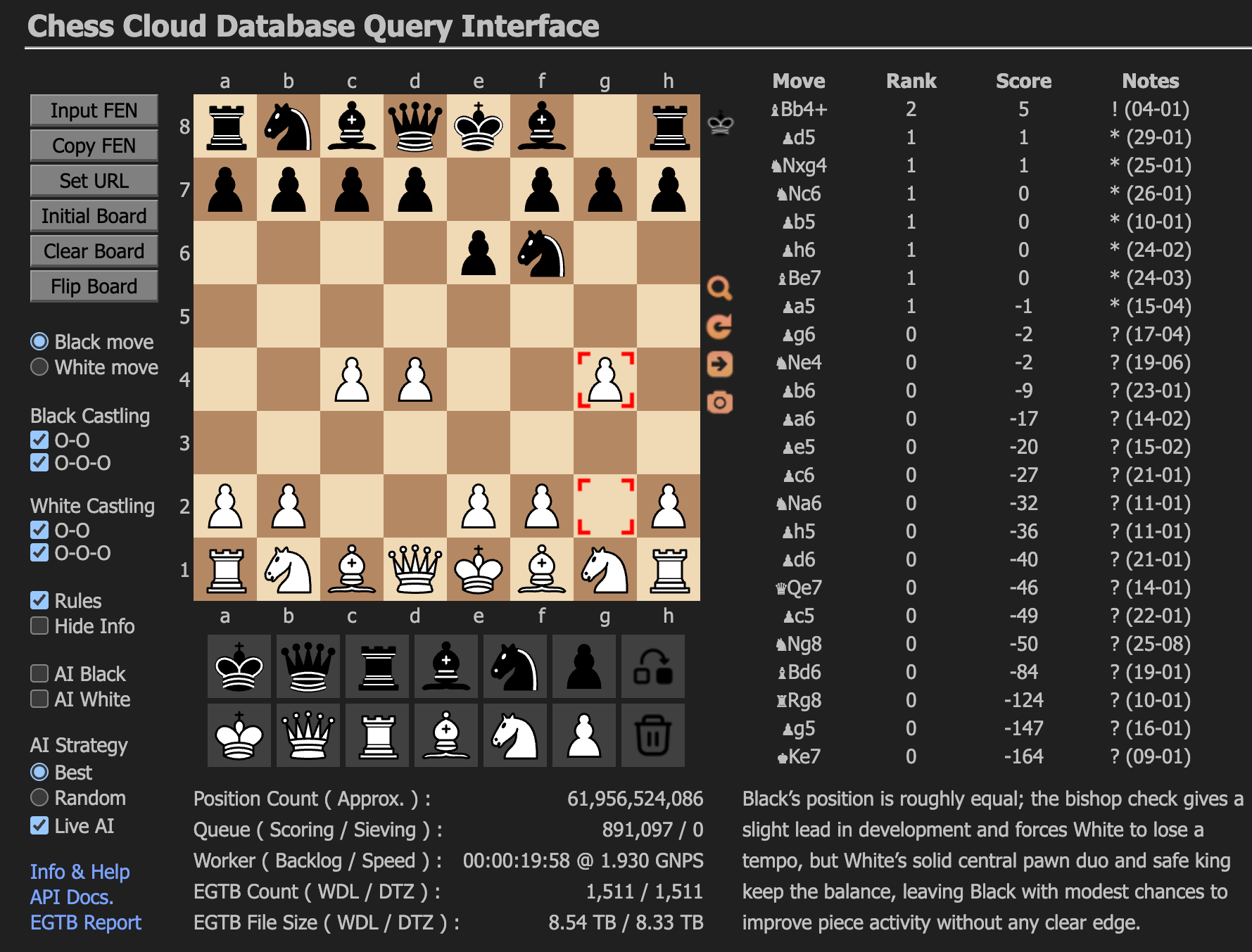
A free resource that belongs in every serious player’s toolkit: the Chinese Chess Cloud Database at chessdb.cn is a continuously updated database of engine-analysed positions built through a distributed computing project. Where Mega and OM CORR give you historical human and correspondence games, ChessDB gives you something different — positions that have been explored by strong engines to significant depth, with move scores and principal variations attached. The practical use in correspondence chess is looking up a specific position and seeing not just what has been played, but what engines have collectively concluded about the main lines, often going considerably deeper than any single analysis session on your own hardware would produce. It’s free, browser-based, and has an API for programmatic access. Not a replacement for local databases, but a genuinely useful sanity check and discovery tool, particularly when establishing whether a line you’ve been investigating has already been resolved in the broader engine community.
Chess Software: ChessBase vs. Aquarium (and When Chessify Suffices)
ChessBase 26
ChessBase is the professional standard for database management, opponent preparation, and game annotation. Version 26 adds a revamped opening report that shows win statistics across Elo bands — useful when preparing against opponents at specific levels — along with a reference search that visualises typical piece paths and Monte Carlo analysis showing the most common figurine trajectories from a given position. For correspondence chess the core workflow is: import your opponent’s games from the Corr and Mega databases, run a player-specific filter, study their repertoire with both colours, and build a preparation tree. ChessBase handles this better than anything else available.
Aquarium 2026 (IDEA)
Aquarium 2026 (currently €48.97) earns its place in correspondence chess almost entirely because of one feature: Interactive Deep Analysis, or IDEA. Where ChessBase analysis is essentially linear — you set an engine running and read the output — IDEA builds a branching tree of engine analysis automatically, exploring multiple candidate moves and their replies over extended sessions. You can set it running overnight and return to a comprehensive decision tree rather than a single-line evaluation. For correspondence chess, where you’re often asking “is line A or line B better, and how far does the difference persist?”, this is a meaningful advantage.
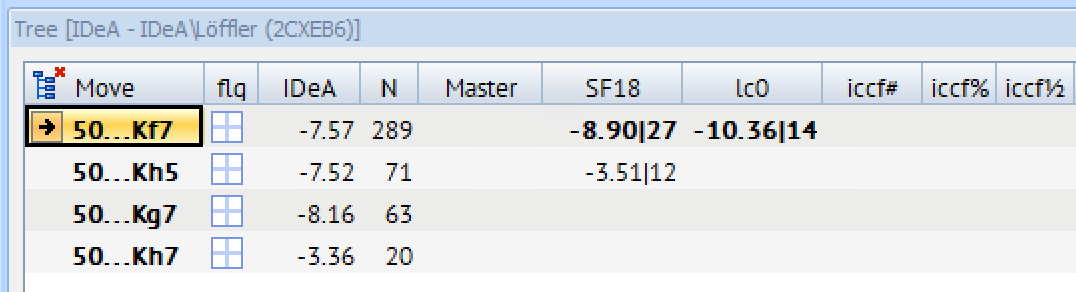
The downside: Aquarium is niche, development pace is slower than ChessBase, and the interface feels its age. Many players use ChessBase for preparation and database work, then Aquarium for deep tree analysis on specific positions.
Chessify
Chessify is a cloud analysis platform, not a chess management program, which makes it a different kind of tool. For players who want to access engine analysis from any device, including mobile, or who want to run Lc0 without owning a strong GPU, it fills a real gap. The free tier gives Stockfish at 1 MN/s. The Amateur plan (~$8/month) opens up unlimited shared-server analysis at considerably higher speeds. Lc0 access requires coins or the GM plan. At the top end, coin-based dedicated servers can push Stockfish to 1 billion nodes per second — a level of hardware that would cost a serious sum to replicate locally, available here on demand for cents per hour. And if that still isn’t enough, Chessify has been known to build custom configurations for those with sufficiently specific requirements, though that conversation probably begins with a somewhat larger budget in mind. Chessify has also integrated the ICCF database (2M+ games) at the Master plan level and upward, and can be used as a remote engine source for ChessBase, Fritz, HIARCS, and SCID — integrating with your existing workflow rather than replacing it. For correspondence chess at a serious level, Chessify alone is not a complete solution, but as infrastructure for accessing raw engine power without local hardware constraints, it’s genuinely worth knowing about.
Engines
At the top level of correspondence chess, Stockfish and Lc0 are the two engines that matter. Everything else is either a cross-check or a source of ideas.
Stockfish 18
Stockfish remains the strongest engine by most measures and the workhorse of serious correspondence analysis. Its NNUE evaluation handles everything competently, but it shines particularly in sharp, tactical positions where precise calculation is what the position demands. If a line is being decided by a concrete sequence five or ten moves deep, Stockfish will find it. Run locally on a modern multi-core CPU with adequate RAM it’s fast enough for most correspondence work. For deeper analysis — very long overnight sessions, or critical positions where you need more certainty — Google Cloud is a scalable option for running your own Stockfish instance without being constrained by local hardware.
Lc0 (with network considerations)
Lc0 — Leela Chess Zero — is the neural network engine, and its character is genuinely complementary to Stockfish’s. Where Stockfish is concrete and tactical, Lc0 evaluates positionally in a way that feels more human: it grasps long-term structural factors, piece coordination, and the comparative value of piece configurations in ways that pure alpha-beta search sometimes undersells.
There’s a technical dimension worth understanding here. Lc0 produces not just an evaluation but a policy — a probability distribution over all legal moves representing its intuitive likelihood of each candidate. Moves that are very strong but score a low policy probability are, by that measure, surprising: the kind of move a strong human wouldn’t naturally consider. When Stockfish confirms that a low-policy Lc0 candidate is objectively the best move, you’ve found something close to a genuine brilliancy.
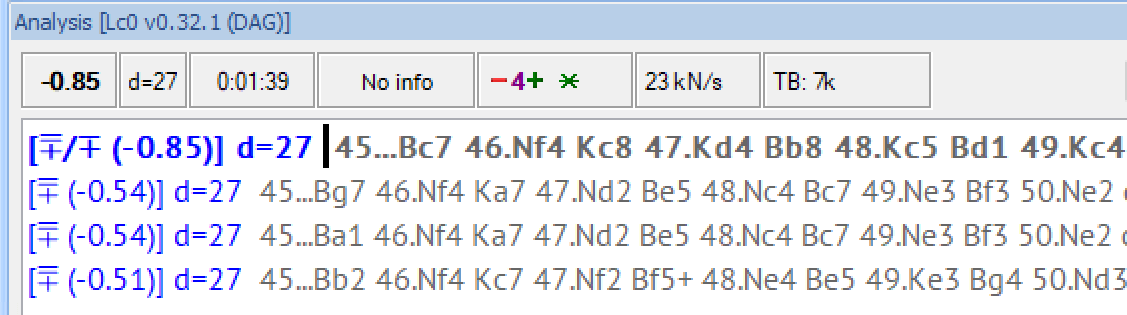
For correspondence chess, though, the most immediately useful divergence is simpler: positions where Stockfish and Lc0 disagree on evaluation rather than on move choice. Those disagreements are flags that demand deeper investigation. Here is a position from my Polish Fischer Random Championship final as an example. After White plays Ng6:
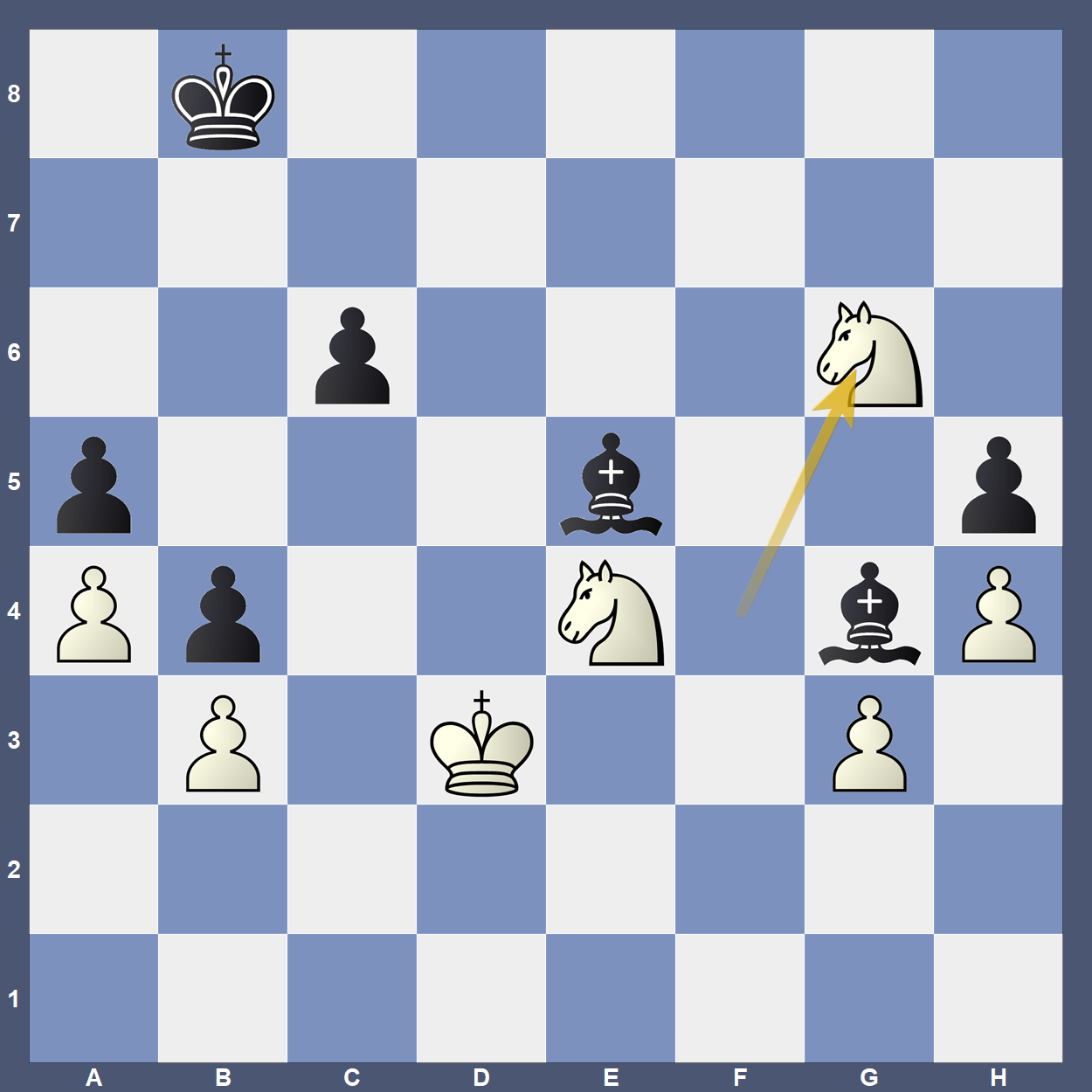
Stockfish 18 evaluated this position at −0.02 — essentially equal, bordering on irrelevant. Lc0 gave −0.85, a significant structural advantage for Black. The position isn’t tactically forcing. What Lc0 is reading, and Stockfish is largely discounting, is something about the long-term relationship between Black’s bishop, the pawn structure, and the activity available to White’s pieces across the next twenty or thirty moves. When two engines of that calibre read a position this differently, the only sensible response is to allocate more time and dig deeper before committing. In a correspondence game you have that luxury; you should use it.
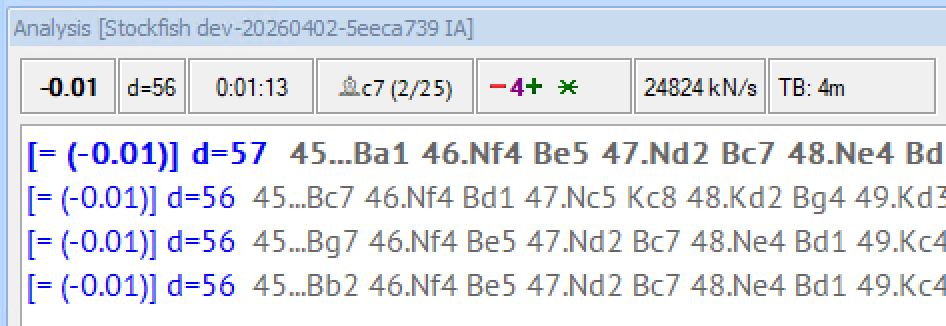
The network you run with Lc0 matters. Larger networks — more parameters, richer positional understanding — are generally preferable for correspondence chess if you have the hardware to run them. Lc0 is GPU-bound, which is its main practical limitation. Vast.ai is the popular cloud solution: GPU instances rentable for cents per hour, allowing you to run Lc0 with a strong network without needing a high-end gaming machine. Chessify also provides Lc0 access via coins or the GM subscription tier.
Other engines
CorChess — a Stockfish derivative specifically oriented toward correspondence chess — has a following in the community and is available on Chessify. In honest practice, it probably doesn’t offer a meaningful edge over Stockfish 18’s main branch, but it’s worth running as a cross-check in critical positions: when CorChess and Stockfish disagree, that disagreement is informative. Similarly, Crystal (which has notable fortress-detection capability in endgames), Caissa, ShashChess, and RubiChess are useful for the same reason. None of them are stronger than Stockfish in general, but they evaluate positions differently, and a position where multiple engines disagree on sign deserves more of your attention than one where everything agrees.
Endgame Tablebases
This is one area where “you should probably know about this” understates the case. Tablebases are part of the infrastructure of the game.
Six and seven-piece: know what you can claim
The Syzygy six-piece set — covering every endgame with up to six pieces including both kings — weighs approximately 149 GB in total and is freely available for download from Lichess servers. On a modern SSD this is a trivial storage investment and a one-time effort. There is no serious reason not to have the full six-piece set installed and configured for your engines. Do it if you haven’t already.
The ICCF formalised the implications: players may claim a win or draw based on Syzygy tablebase evidence — six-piece since 2014, extended to seven-piece following the 2019 Congress. This isn’t merely an analytical tool — it’s a claims mechanism. If your opponent is in a tablebase position that is certified as drawn, you can enforce that result regardless of what the position looks like on the board.
Seven-piece: selective download is the only practical approach
The complete seven-piece Syzygy set totals approximately 16.7 TiB — far beyond what any personal storage setup can reasonably hold. The answer is to be selective, guided by frequency of occurrence.
The top seven-piece endgame by frequency is KRPPvKRP, which arises considerably more often than any other and should always be the first download. The next tier includes KBPPvKBP, KPPPvKPP, KRPPPvKR, and KQPPvKQP. The Komodo/Dragon documentation recommends starting with KRPPvKRP and KPPPvKPP (totalling roughly 35 GB combined), and their Syzygy7.pdf lists the top 48 most common seven-piece endgames — a useful guide for building a selective collection. A practical target for most serious players is the top 20 by frequency, which covers the vast majority of positions you’ll actually encounter.
The download process, done by hand from the Lichess tablebase server, is genuinely time-consuming — there’s no polished tooling that makes it painless, and the files for the top 20 endgames alone run to several hundred gigabytes. A dedicated SSD is necessary rather than optional: engine probing requires the read speeds that spinning disk simply can’t provide. The setup is a commitment. But once it’s done and your engine configuration points at it, the result is silent and perfect: instantaneous knowledge of those positions whenever your analysis reaches them. One of those infrastructure investments that you make once and then forget about in the best possible way.
For material configurations you haven’t downloaded locally, syzygy-tables.info provides free web-based lookup for all positions up to seven pieces — handling the long tail of unusual material that you’ll encounter perhaps once per tournament.
Beyond Tablebases: FinalGen and Alternatives
FinalGen is a dedicated endgame tablebase generator for positions that fall outside Syzygy coverage. Given time and computing resources, it can generate an exact result for a specific position — not an evaluation, not a probability, but a definitive win, draw, or loss. For those needing four-piece depth-to-mate analysis specifically, Hoffman is an alternative that reports DTM (distance to mate) rather than Syzygy’s DTZ metric — useful when you want to know the minimum number of moves to checkmate rather than merely the distance to the next pawn move or capture.
The scenario where these tools matter most in practice isn’t usually “can I win this endgame.” It’s the decision that happens before the endgame: whether to enter it at all. A typical situation: you’re in a complex position and one conversion path leads to a pawn-and-piece endgame that your engines assess as “slightly better,” but you can’t determine whether that edge is real and convertible or whether it collapses into a fortress where your opponent parks their pieces and the win disappears. Running FinalGen on the target endgame position before you commit to the conversion path can give you a definitive answer — which completely changes how you approach the twenty preceding moves.
I’ve had games where exactly this calculation mattered: a moment where simplification was available but the theoretical status of the resulting endgame was genuinely unclear. The engine said “better.” The actual question was “better enough, and can Black hold a fortress?” Knowing the answer before you make the choice is what these tools provide. Like the seven-piece tablebases, you won’t reach for them often. But the positions where they’re relevant tend to be the ones that decide tournaments.
How it Actually Fits Together
The tools described above don’t live in isolation — they form a workflow. Here is roughly how a serious analysis session on a specific position might look in practice.
You start from the position on the board and search for it across your databases — Mega, Corr, OM CORR, and ChessDB.cn simultaneously. You filter the results: recent games only, a minimum rating threshold, no short draws. This gives you the human and engine-validated map of where theory currently stands in that position.
In parallel, you run engine analysis: Stockfish and Lc0 in infinite analysis, engine matches from the position, ChessBase’s Monte Carlo analysis for statistical trajectory, and Deep Position Analysis for slower, broader evaluation. ChessDB.cn serves as an independent cross-check on whatever your local engines are suggesting.
All of this — the filtered game sets and the engine lines — feeds into Aquarium’s IDeA project. IDeA seeds itself with these inputs, adds any new positions it encounters as tasks, and runs overnight (or for days, in critical positions), continuously updating the branching evaluation tree. You return to explore the results, identify the lines that demand further attention, expand them, and repeat.
The loop is: search → analyse → seed IDeA → explore → repeat, with ChessDB.cn as a sanity check throughout. It sounds systematic because it is. Correspondence chess at a serious level is closer to research than to game-playing, and this is what the research process looks like.
Putting it Together
A sensible configuration for a serious correspondence player today: core theoretical books with their key claims verified against current engines; Mega and Corr from ChessBase plus OM CORR for correspondence coverage and ChessDB for free engine-validated lookup; ChessBase 26 for preparation and database management, with Aquarium for IDEA tree-building; Stockfish locally as the workhorse, Lc0 via Vast.ai or Chessify for positional cross-checking, other engines as disagreement detectors; six-piece Syzygy in full, seven-piece downloaded selectively by frequency with syzygy-tables.info for the rest; and FinalGen for the position you can’t resolve any other way.
The total investment — in money, in setup time, in the learning curve — is real. But then, so is the game.
Amici sumus — Paweł
PS: All tools, databases, and services mentioned in this article are ones I use or have evaluated myself. I have no affiliate relationships with any of them, receive no commission or compensation for links, and paid for everything out of my own pocket — or found it free. The prices quoted were accurate at time of writing but may change.
Excellent article. What are your views about using coins to accelerate engine speeds online or using other engines apart from Stockfish, e.g on Chessify or ChessBase?
Unfortunately the chessbase corr database is incomplete for ICCF games. As an example, it only includes 324 of my own ICCF games rather than the 550. I’ve seen similar with other players. Better in my opinion is Ultra Corr from Tim Harding. Unfortunately his last update was 2025. I just add the newest ICCF games to that. I have CORR 2026 from chessbase also, just to be aware of what users see there and for the correspondence games from sources other than ICCF. But would recommend anyone using just chessbase corr to also download the iccf database and be prepared to add the missing games (at least as you prepare for opponents).