



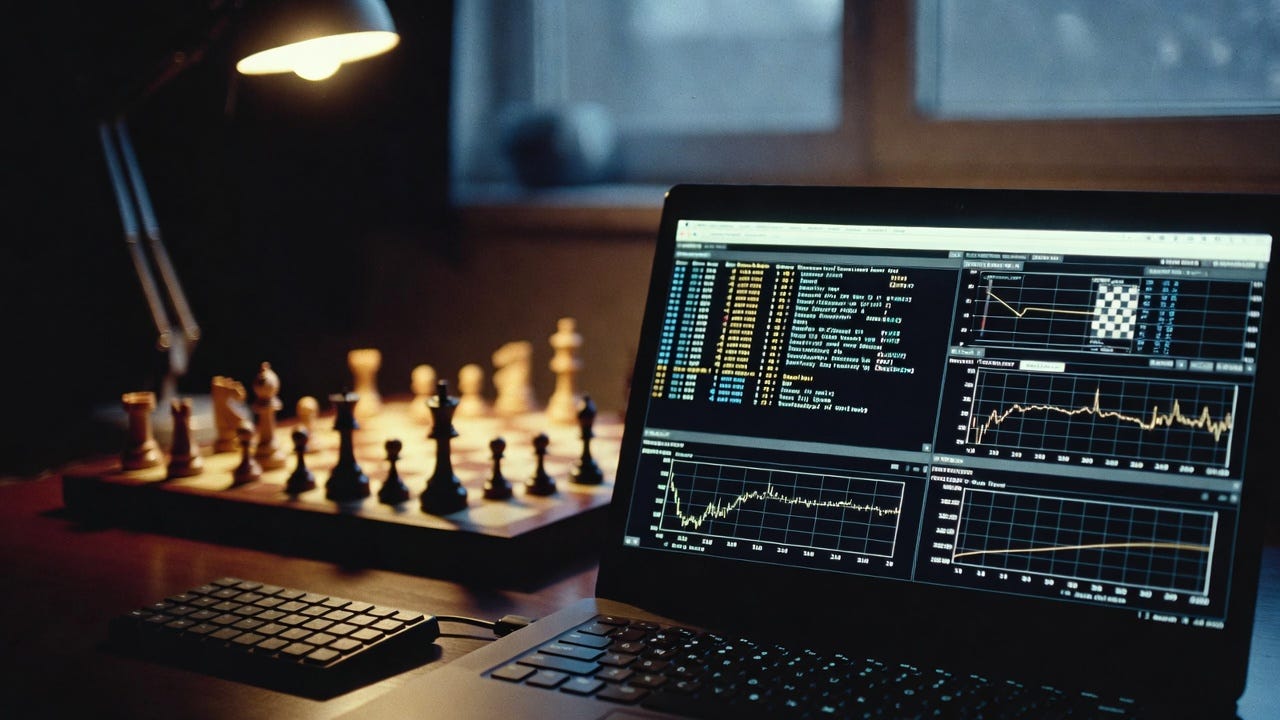
Sean Clark wrote this piece for the EFCC Magazine, which was unfortunately discontinued before it could be published. I am glad it has found a home here instead. It is aimed at those already familiar with chess who are new to correspondence play — and it addresses, from a personal rather than technical perspective, the question every correspondence player must eventually answer for themselves.
— Paweł
The answer to this question is a journey, and all journeys have a beginning if you will indulge me.
I first encountered chess as an eight-year-old at my uncle’s house, learning the rules under his guidance. Growing up in the 1970s and 1980s, I witnessed the chess world undergo some dramatic changes. Bobby Fischer was fading into obscurity, Garry Kasparov was rising to fame, and Nigel Short was creating a stir as Britain’s prodigious young talent. Chess even made it to mainstream media with The Master Game, a BBC series that sought to popularise this ancient art.
Despite the excitement around the game, I grew up in a small village where chess wasn’t exactly a part of daily life. My world was filled with fantasy novels, Dungeons & Dragons, and sci-fi escapades. Living in a country pub, I found ways to entertain myself indoors in winter and outdoors in the warmer months. Chess was a fleeting interest, with no one nearby to play. Chess clubs were out of reach, there was no internet, and my school lacked a chess program. Besides, my family wasn’t exactly brimming with chess enthusiasts.
That all changed when I acquired my first computer in the 1980s: the glorious ZX81 with its impressive 16KB of expanded memory. Suddenly, I had an opponent at my fingertips — although a silicon one, it was at least willing. With no tutor or exposure to chess literature, my learning was piecemeal at best, but I enjoyed the occasional match against the computer.
As I moved into my teens, golf took centre stage, and chess receded. And then came the usual suspects: studying, working, and, of course, girls! Chess became a puzzle, something to dabble with here and there, but nothing I took particularly seriously. I was still drawn to physical chess sets, buying the occasional cheap wooden set from holiday spots like Greece and Spain. However, these beautiful boards often ended up gathering dust due to a perpetual shortage of opponents — a common fate for many holiday chess purchases, I suspect.
The internet, however, changed everything. With the advent of online platforms, I could play any time against opponents worldwide, and the anonymity suited me. In traditional chess clubs, I felt out of place. Members were either gifted youngsters or seasoned veterans who had been at it for decades. I was neither, and while I loved the game, deep analysis and memorised positions were beyond me. Online, though, I could just enjoy the game, free from in-depth discussions on positional play that, frankly, went over my head.
Time was my other nemesis. Bullet games — those exhilarating one-minute blitz rounds — were a thrill, but I lost time and again due to my lack of instinctual play. Correspondence games, with their multi-day time controls, were a revelation. Here was a game I could play at my own pace. However, even there, I found some opponents abandoning their games halfway, which made the victories feel hollow.
Then I discovered ICCF and EFCC, the formal world of correspondence chess. Now, this was serious. Titles were on offer, and I could represent my country in international competitions. My first invitation to play for England filled me with pride. I told everyone I knew. My uncle, the very man who taught me to play, was especially thrilled. After all, he had taught the first person in our family to represent their country in any sport at any level! It was a surreal moment, as though a pastime I had cherished privately was suddenly validated.
In correspondence chess, I could delve into the richness of each position, take my time, and compensate for my lack of chess knowledge with computer assistance. I used engines, not as a crutch, but as a guide through complex positions. What felt like cheating at first soon became a valuable tool in my arsenal. And, as I learned the hard way, blindly following engine moves without understanding why doesn’t guarantee victory.
In recent months, my pursuit has become more serious as I work toward my first title. I approach each game with a much deeper analysis, going beyond superficial moves to uncover strategic depths. I prefer aggressive lines if the odds favour me, even if it’s not the engine’s “first choice.” With time on my side, I stick to a select few openings, diving into intricate positions and developing a true appreciation for the nuances within.
Engines no longer feel like an affront to the purity of the game; instead, they are an enhancement, helping me spot patterns I missed in my younger days. Today, I no longer wonder, “What’s the right way to use an engine in correspondence chess?” because I’ve learned that each player must find their own answer. Engines, much like chess itself, can be as rigorous or relaxed as you choose to make them.
My approach to engine use varies by game. I often use conditional moves to clarify a draw or signal a well-prepared sequence to my opponent. Why continue a game that’s all but decided when there are countless others to savour? It may be a bit cheeky, but it’s also the freedom I missed in my early years with the game.
One final note on engines: everyone playing on ICCF can access them. Despite this, draws are common, and there are still those who lose despite the advantage of technology.
At the end of the day, there is no right way to use an engine in correspondence chess. It’s about enjoying the game your way.
— Sean Clark
Further reading
While on the subject of correspondence chess resources: I also want to draw attention to the blog of Christer Sundqvist, an International Correspondence Chess Master from Helsinki, at chessturpaduunari.blogspot.com. Christer has produced extensive analysis packages on the f3-Nimzo-Indian, the Sicilian Najdorf, and the Queen’s Gambit Accepted — all developed through the lens of correspondence chess, where theory genuinely goes deeper than anywhere else. If you play any of those openings and want to see what serious correspondence preparation looks like, his blog is essential reading. It is exactly the kind of resource The Sealed Move exists to surface.
