


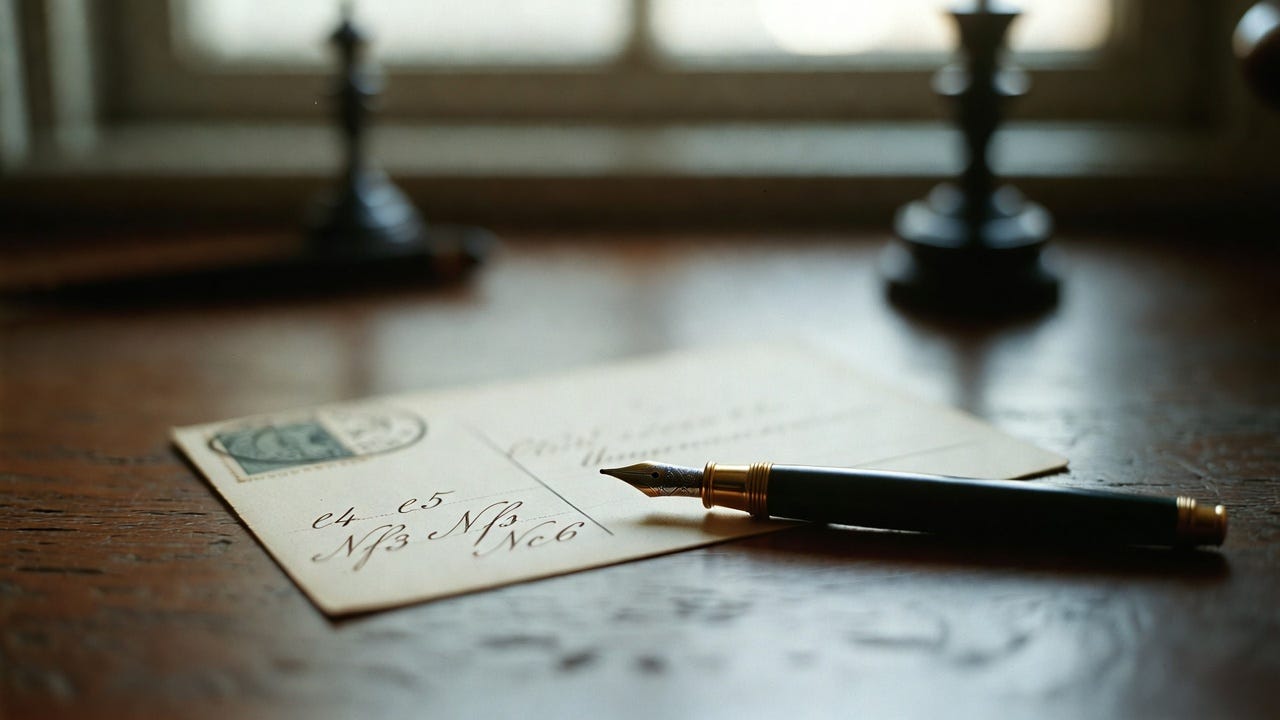
There is a move sitting on a server in Germany right now that has been waiting three weeks for a reply.
The player considering it has a position open on his screen. He has run it through an engine, consulted databases of previous games, slept on it, changed his mind twice, and is now reconsidering a variation he dismissed a fortnight ago. He is not in a hurry. His opponent, somewhere in another country, is doing the same thing with their own positions in their own time. They may never meet. They are, in a meaningful sense, playing the same game of chess — just not at the same time.
This is correspondence chess. And if you have never heard of it, you are not alone.
A game without a clock
Most people who know chess know it as a timed game. You have minutes, sometimes seconds, to find your move. The clock ticks. You decide. The pressure is part of the drama.
Correspondence chess removes the clock entirely — or rather, replaces it with something almost unrecognisably different. Players are typically given between 10 and 50 days per move. Some tournaments allow even more. A single game can last years. A world championship match conducted by correspondence has historically taken the better part of a decade to complete.
The effect on the chess itself is profound. Decisions that in over-the-board play must be made in minutes — under pressure, imperfectly, with incomplete calculation — can in correspondence chess be examined to their logical conclusion. Every variation can be followed to its end. Every assumption can be tested. The result, at the highest levels, is chess of a depth and precision that no over-the-board game can match.
How it began
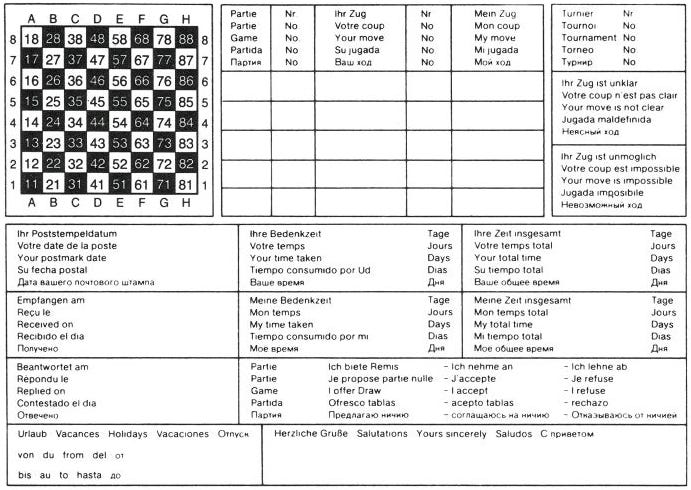
Correspondence chess is older than the telegraph. The first recorded correspondence game dates to 1804, played between two Parisian chess clubs by exchanged letters. By the mid-19th century, matches between cities and countries were commonplace — London versus Edinburgh, England versus France. Each move was written on a postcard or letter, posted, and awaited.
The pace was not a limitation. It was the point. Players had days or weeks to think because the post took days or weeks to arrive. The game adapted to its medium.
As communication accelerated, so did correspondence chess. Telegrams replaced letters for important matches. Email eventually replaced telegrams. And then, in the 1990s and 2000s, dedicated servers emerged — platforms where players could submit moves, track games, and compete internationally without ever exchanging a physical letter.
Today the International Correspondence Chess Federation, the ICCF, administers tens of thousands of games simultaneously across its web server. Players from over 60 countries compete in national team championships, thematic tournaments, and individual title events. The World Championship is a multi-year, multi-stage competition contested at a level of theoretical preparation that would be unrecognisable to the players who posted their moves by hand two centuries ago.
The postcard is gone. The patience remains.
The engine question
The arrival of strong chess engines — software that can calculate millions of positions per second and plays well beyond any human — changed correspondence chess irrevocably. The ICCF permits engine use in most of its events. This is not a concession to cheating; it is an acknowledgement of reality, and a philosophical choice about what correspondence chess is.
The argument for permitting engines runs like this: correspondence chess has always been about finding the best move with the resources available. In the 19th century, those resources were books, analysis boards, and time. Today, they include engines. The challenge has not disappeared — it has shifted. With engines, both players have access to the same raw calculation. What distinguishes them is preparation, understanding, and the ability to navigate positions where engines themselves are uncertain.
In practice, the highest levels of correspondence chess have become a dialogue between human understanding and machine calculation. The engine tells you what the computer thinks is best. The correspondence player must understand why, must navigate the transition from opening to middlegame to endgame, and must make judgments in positions where the engine’s evaluation wavers — where the silicon is, in a word, unsure.
Those are still human decisions. They are simply better-informed ones.
What correspondence chess produces
The games produced at the top of correspondence chess are unlike anything else in the sport. Theoretical novelties — new ideas in known opening positions — appear in correspondence games years before they reach over-the-board play. Endgames are conducted with a precision that approaches the theoretical ideal. Middlegame combinations are calculated to depths that would be impossible for any human mind working under time pressure.
The ICCF database contains millions of correspondence games. It is, in a real sense, the deepest record of what chess actually looks like when humans and machines work together without constraint. Grandmasters preparing for over-the-board tournaments study correspondence games for precisely this reason: they show what the position truly demands, without the noise of time pressure and fatigue.
Some of the most beautiful games in chess history were played by correspondence. They are almost entirely unknown to the general public. That is one of the things this publication exists to change.
Who plays it
Correspondence chess has always attracted a particular kind of player. Not necessarily the strongest over-the-board player — though many strong players have competed by correspondence — but the most analytical, the most patient, the most interested in chess as an intellectual exercise rather than a competitive spectacle.
It has also, historically, been genuinely international in a way that over-the-board chess was not. During the Cold War, correspondence chess was one of the few arenas where players from the East and West competed on equal terms, their moves crossing borders that their bodies could not. National team championships — the ICCF Olympiad — were bitterly contested between the Soviet Union and the West for decades. The games themselves were diplomatic dispatches of a kind.
Today the game is smaller than it was at its peak, but the community is serious, dedicated, and largely invisible to mainstream chess culture. There are no correspondence chess streamers. There are no correspondence chess influencers. There is, as far as I am aware, no publication devoted to it for a general audience.
Until now.
A personal note
I have been playing correspondence chess for some time now. I hold the title of Senior International Master at the ICCF — one of the federation’s senior competitive titles — and I am the current Polish national champion in Fischer Random chess, the variant in which the starting position of the pieces is randomised, eliminating opening preparation and testing pure chess understanding.
I am also Polish, which brings me to a small digression worth making.
This year marks the 100th anniversary of the Polish Chess Federation — a century of organised chess in a country with a proud and sometimes dramatic chess history. The federation has begun its anniversary year with a commemorative tournament, details of which are here. For anyone with an interest in Polish chess, or in the broader history of European chess organisation, it is worth reading.
Correspondence chess rewards patience. So does this publication. Posts will arrive when there is something worth saying.
If you play correspondence chess, have played it, or are simply curious about what serious chess looks like when time is not a constraint — you are in the right place.
Paweł Fiedor — Senior International Master, ICCF & Polish National Champion, Fischer Random Chess