


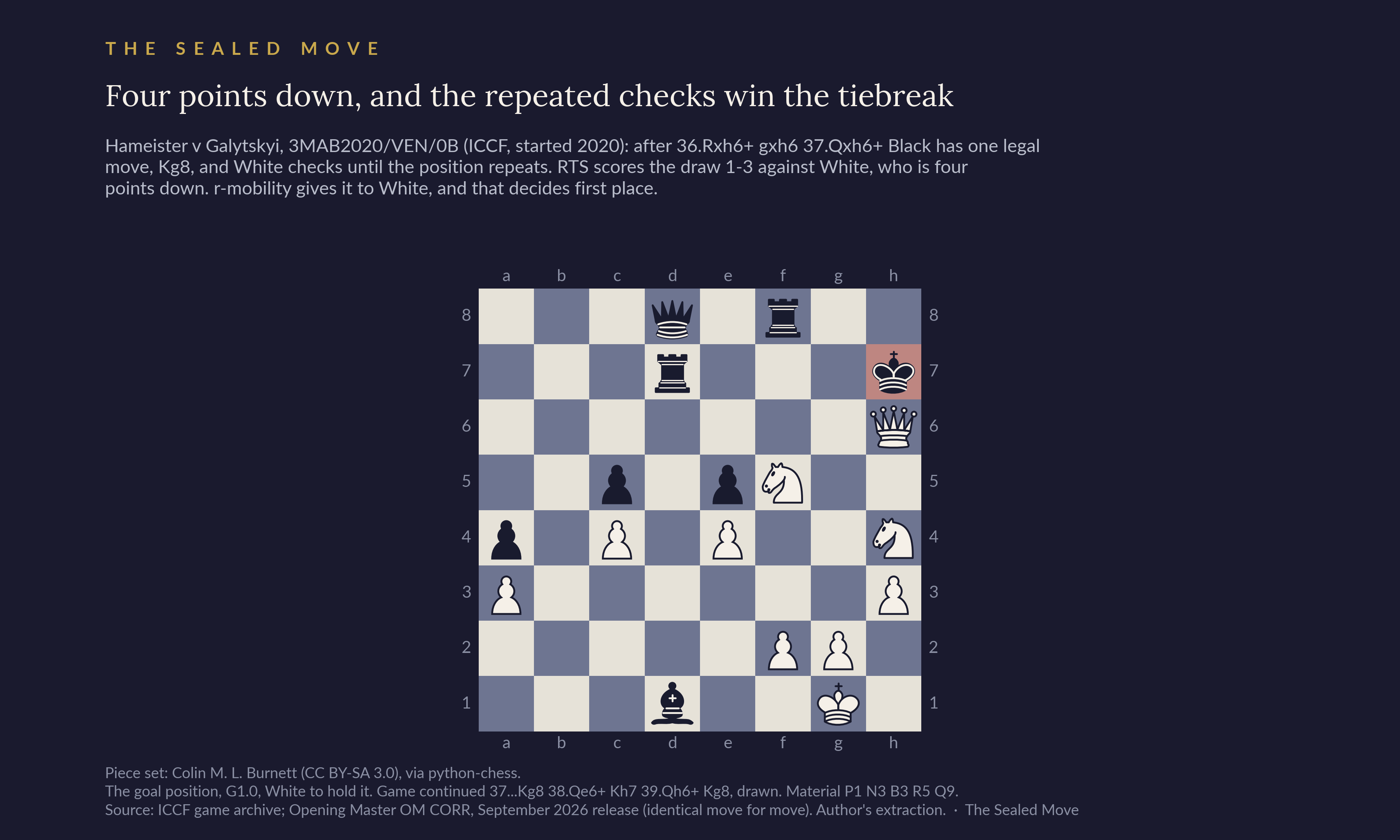
In the third Alberto Barreras Memorial, an ICCF event that started in July 2020, Raik Hameister, with White against Volodymyr Galytskyi, gave up a rook on h6, recaptured with the queen and checked the black king until the game was drawn. Hameister finished four points down on material. Under the Rutar Tiebreak System, the proposal that went to this year’s Congress, that draw scores 1–3 against him. Under r-mobility, the tiebreak the Top Chess Engine Championship has used, it is his draw, and in that event it decides who finishes first.
The two systems came up together at Congress. Mariusz Wojnar, the Polish delegate, wrote in his report of the Congress (published on kszgk.com, the site of the Polish correspondence chess association) that RTS resembles “other experimental solutions that assess an additional aspect of the final position”, and named r-mobility as the example. Both, he wrote, risk setting a side objective next to the main one, which is to play the best chess.
According to the same report, proposal 2026-069 was withdrawn after delegates concluded that a trial needs neither a rule change nor new infrastructure. Test events can still run, so the question stays open. In “Counting the Pieces” I scored the elite draws of 2016–2020 and 172 complete ICCF round robins under RTS. Here I score the same games under r-mobility. Its answer has little to do with material.
The rule
TCEC’s rules include r-mobility as a tiebreak criterion; its Season 20 rules list it second, after the direct encounter. According to the TCEC wiki (April 2023), it has been needed once, in the Season 18 Top 4 bonus. It was devised by Aloril, a TCEC administrator, as a generalisation of Lasker’s idea that a stalemate should be worth more than a draw.
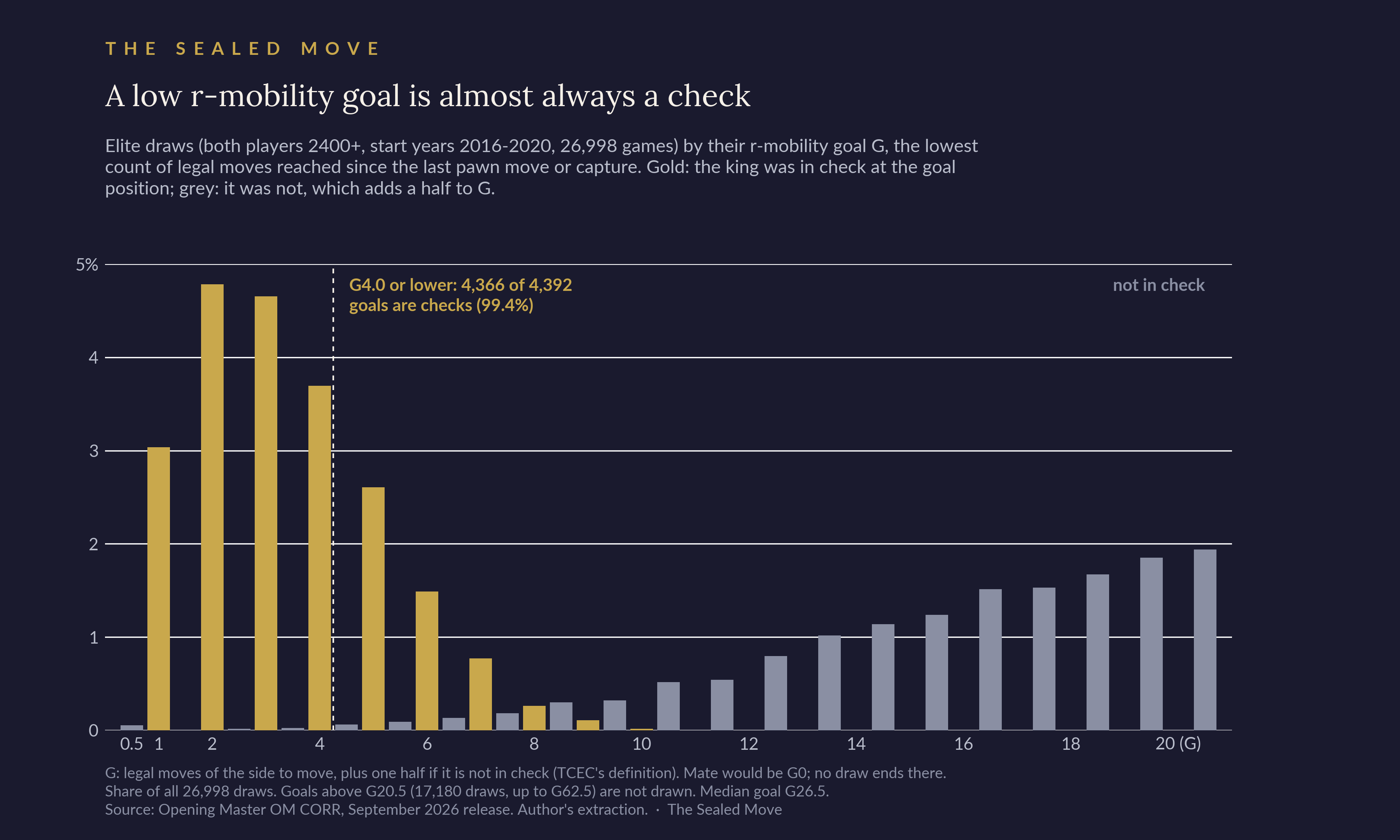
The rule counts G, the number of legal moves of the side to move, plus a half if that side is not in check. Mate is G0. Stalemate is G0.5. A king in check with one move is G1.0. Only positions since the last pawn move or capture count. The lowest G reached in that stretch is the game’s goal, credited to the side that moved into it; if both sides reach the same value, the first keeps it. The holder of a drawn game scores ½ + ½^(1+2G) and the other side the rest. The event tiebreak is the sum over all games.
One thing follows from the arithmetic before any game is scored: the bonus collapses quickly. At G5.5 it is about two ten-thousandths of a point. A harmonic variant, ½ + ½/(1+2G), was proposed in TCEC’s community discussion for that reason, and I report it alongside.
I implemented the rule from the TCEC wiki and the code of TCEC’s own interface, and checked the implementation against the Season 18 results Aloril published: all 65 published quantities agree. The games are the ones from the first piece. r-mobility sits where RTS sat in the tiebreak order, so that only the scoring differs.
It settles every tie
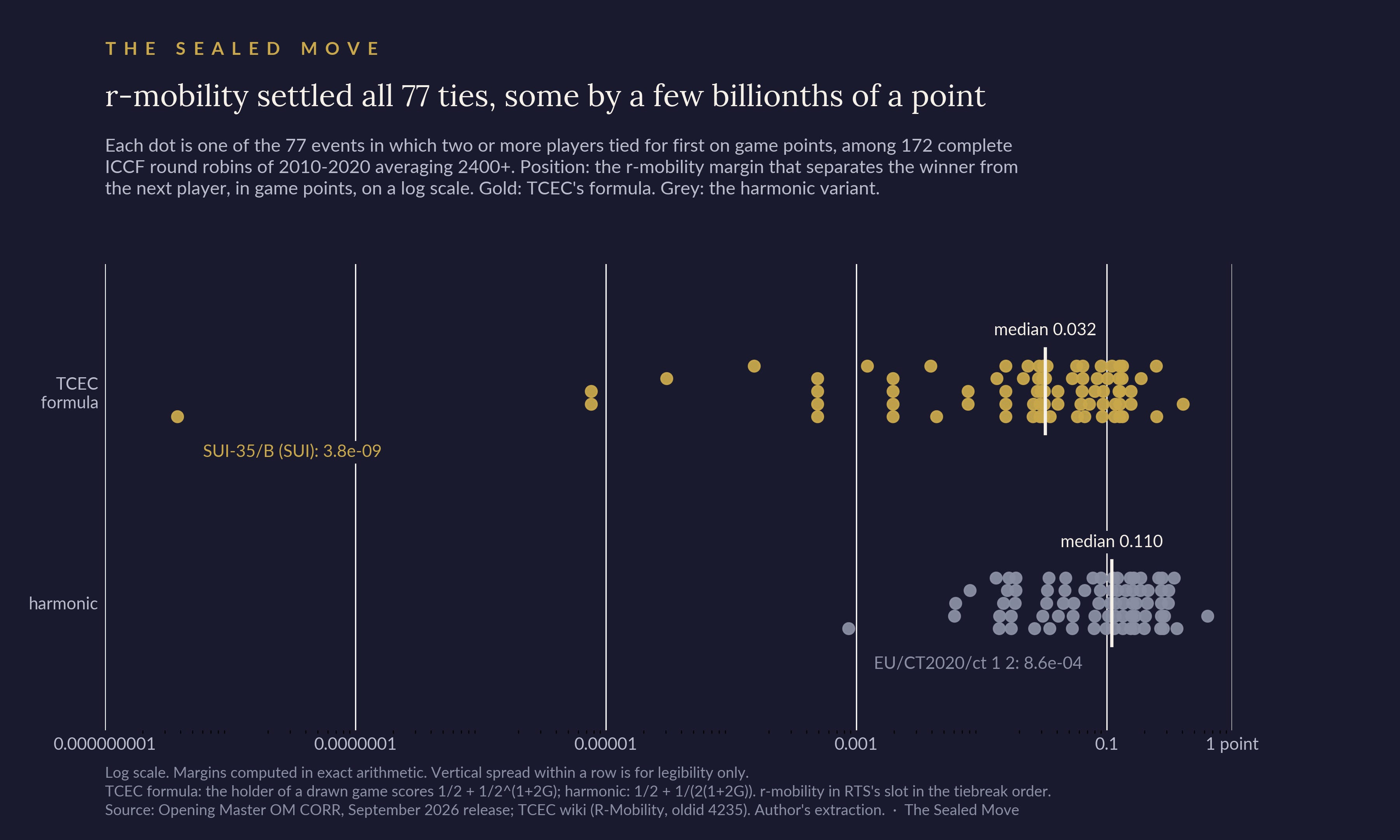
Of the 172 events, 77 had a tie for first on game points. r-mobility separated the players in all 77. RTS, with its later criteria, separated 70; the current ICCF order 35. Across the 172 that is 172 single winners under r-mobility, 165 under RTS and 130 now. r-mobility changes the winner from the current order in 58 events and from RTS in 54. The two tiebreaks proposed as alternatives to the present one disagree about who won in most of the events where either decides anything.
What it decides by is another matter. Most draws contribute next to nothing: the median goal in an elite draw is G26.5, and 83.7% of elite draws carry a bonus below a thousandth of a point. The margin that decides an event is larger, because it comes from the few draws that end low. Its median is 0.032 game points, about one draw at G2.0. Nine events are decided by less than a thousandth. The smallest margin, in SUI-35/B (2020), is 3.8 billionths of a point. Under the harmonic variant the margins are roughly three times larger and the winner changes from the current order in 63 events.
What decides: the holder’s check
Take the elite draws whose goal is G4.0 or lower: 4,392 games. In 4,366 of them (99.4%) the goal was reached by a check. In 4,219 (96.1%) the side holding the goal also gave the last check of the game. The goal falls late, a median of two plies before the end, and in a third of these draws it is the final position.
The same pattern runs through the events. For each of the 77 I took the deciding draw, the one whose rescoring as ½–½ moves the margin most, and rescored it. First place changes in 46 of the 77, always to a different single winner. In all 46 the goal was reached by a check, and the holder gave the last check. Forty-five different players hold those 46 goals, so this is not one player’s style.
How do those 46 draws end? In 25 the holder checks and the game ends without a repetition, 12 of them on the checking move itself.
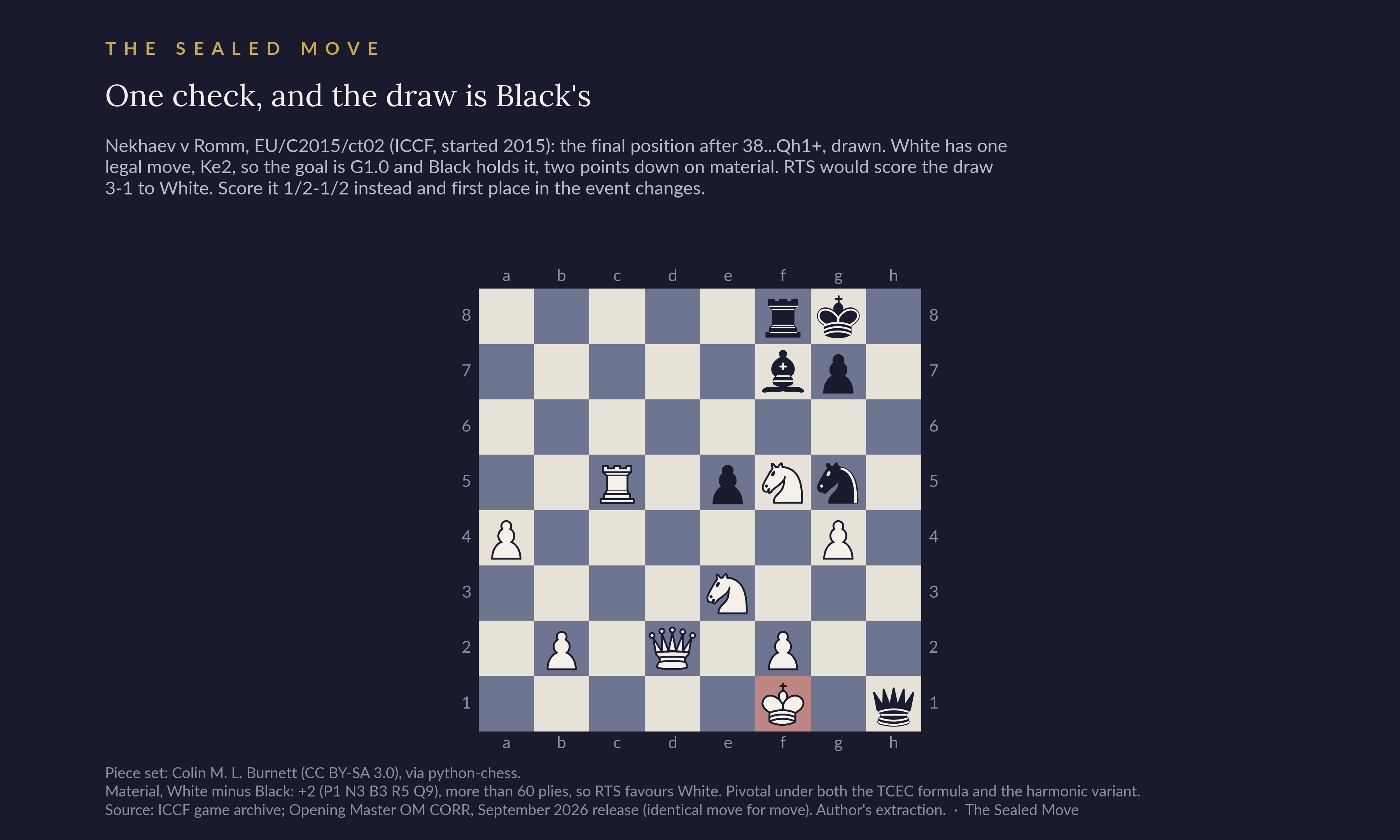
In that event, a candidates’ section of the 2015 European server championship, which started in March that year, Andrey Nekhaev and René Raijmaekers finished level on 8.5 points with three wins each and the same Sonneborn-Berger score, and ICCF’s crosstable lists them both in first place. RTS puts Nekhaev first: his draw with Mikhail Romm ended with him two points up, and RTS scores it 3–1 to him. r-mobility gives the same draw to Romm, who gave the last check, and puts Raijmaekers first. With only two players tied, that one check decides between them. Both players qualified for the final either way; what the tiebreak would have changed is the name at the top.
In 17 the game ends in a perpetual, by which I mean here a repetition in which one side checked on each of its last three moves; the record shows the checks, not that they were forced. In the other four the position repeats without a run of checks.
One fair objection is that any tiebreak among a few tied players hangs on a few games. It does. RTS settles 59 of the 77 ties on its total and 11 more on its later criteria. On those 59, the same test changes first place in 20 under RTS and in 31 under r-mobility; event by event, only r-mobility moves in 19 and only RTS in 8. Sonneborn-Berger, tested the closest way it can be (rescoring one decisive game between players outside the tie), changes first place in 15 of the 35 events it decides, against 17 for r-mobility on the same events. In this sample r-mobility leans on a single game somewhat more than RTS and about as much as Sonneborn-Berger. What separates the rules is which game decides.
The perpetual
The clearest case is the one raised against RTS before Congress, and repeated in Mariusz Wojnar’s report: a player may avoid a sound continuation, even a sacrifice that leads to a safe draw, because ending the game with less material would cost him under RTS. One way such a sacrifice ends is in repeated checks, and those endings the data can count.
The data show how common that case is. 725 elite draws end in a repetition with checks, 2.7% of the 26,998. The side giving the checks holds the r-mobility goal in 707 of them (97.5%). In 286 the checker is behind on material, the largest group, and RTS scores those draws 1–3 against it. r-mobility gives the checker the goal in 281 of the 286.
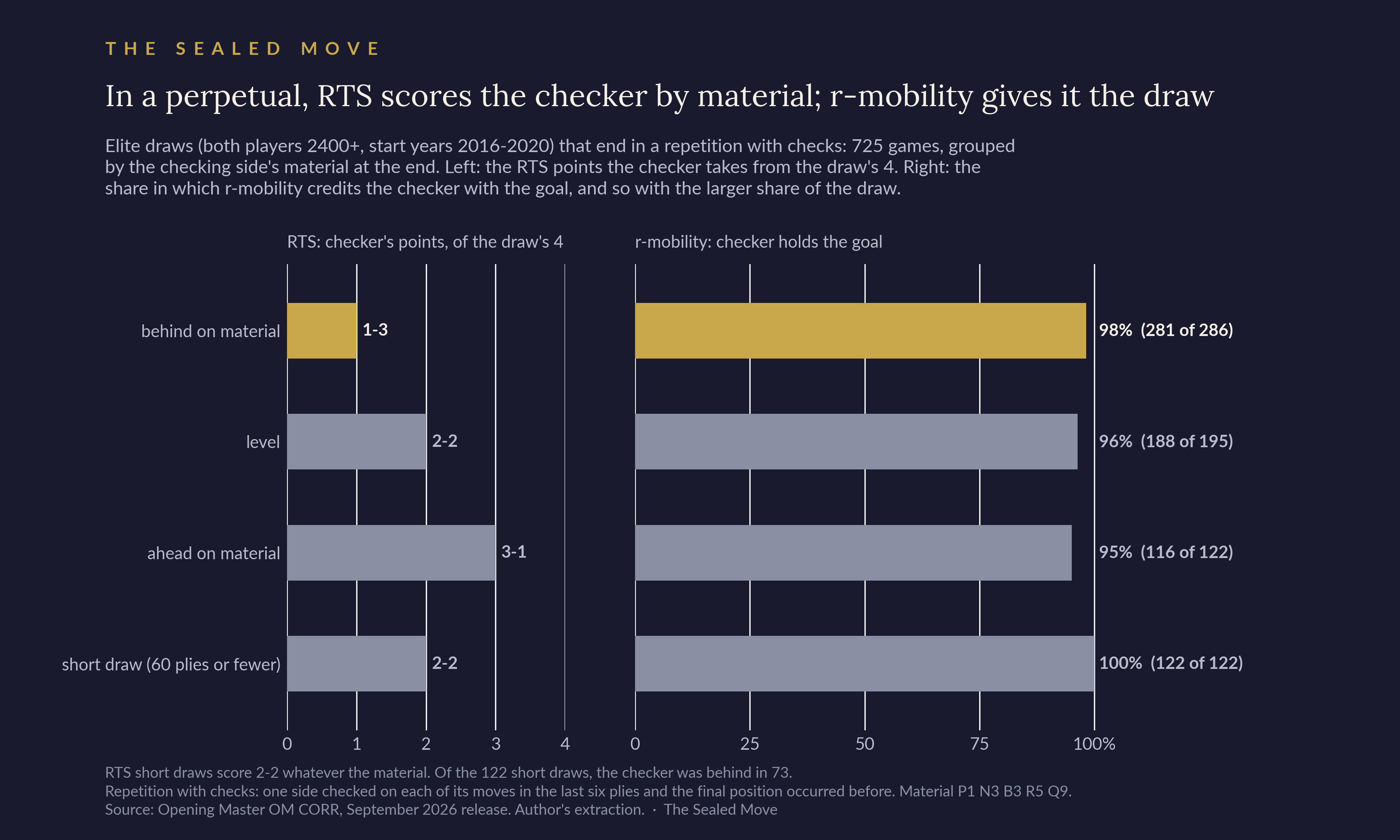
At the level of events, seven different games decide first place in exactly this way: a repetition with checks by the side one to four points down, scored 1–3 by RTS and won by the checker under r-mobility. The opening game of this piece is one of them.
r-mobility does here what it was designed to do. Checking after a sacrifice until the position repeats is forcing play, and restricting the opponent’s king is the thing r-mobility values. RTS was designed to value keeping material, and it does that. The two rules reward different things, and in the largest group of these repetitions they reward opposite players. A federation choosing between them is choosing which of those to reward.
The chosen end
TCEC games end when the engines play them out or the adjudication rules stop them. An ICCF draw usually ends by agreement, one player offering and the other accepting, or by a claim. A rule that scores the last few positions scores a decision the players make.
The scored stretch is short. Since the last pawn move or capture, an elite draw has a median of three positions, and in 32.5% of draws it is one. Under r-mobility the interests in that stretch are opposed: the side that holds the goal wants the game to stop, the other side does not. An agreed draw needs both. A repetition can be claimed by one. So the holder is strongest when it can bring about a repetition with checks, and otherwise depends on the opponent accepting a draw with the goal where it is. The 46 deciding draws show both routes: 21 end in a repetition, 25 in a check followed by an agreed or claimed end.
RTS has the same exposure through material, as the first piece found in draws agreed halfway through an exchange. r-mobility’s exposure runs through the check. Historical games cannot show how players would behave once either rule existed, and I have not tried to simulate it: thinning the bonuses at random, as I did for RTS, would model no adaptation anyone would actually make to a rule about checks.
One last descriptive fact, on two different bases. White holds the r-mobility goal in 56.8% of all elite draws. Among the 8,200 longer draws in which RTS favours one side, White is the side ahead in 64.3%.
What a trial should watch
If either rule is tested, three numbers are cheap to track and should be fixed before the first game: the share of draws whose goal is a check, the share of perpetuals given by the side behind on material, and the share of draws whose scored stretch is a single position. Set against the history above, they would show whether recorded endings change once a rule rewards them. They cannot by themselves show why.
My own reading is that r-mobility is a reliable way to produce a winner on a narrow basis. In the draws that decide events, it rewards the side that gave the last check. Whether that is a better signal of pressing than material is the question a trial would need to answer. The history shows only that the two rules answer it in opposite directions, most sharply in the perpetual, where one punishes the sacrifice and the other rewards it.
SIM Paweł Fiedor
Methods. Games: Opening Master OM CORR, September 2026 release. Elite draws: both players rated 2400+, start years 2016–2020, 26,998 games. Events: the 172 complete ICCF round robins of 2010–2020 averaging 2400+ that the database holds in full, as in “Counting the Pieces”. r-mobility as defined on the TCEC wiki (wiki.chessdom.org/R-Mobility, oldid 4235) and in TCEC’s interface code. Two fifty-move exceptions exist, neither applied by the interface: the wiki ignores the position that triggers a fifty-move end, and Aloril’s scoring script ignores every position at a halfmove clock of 100 or more unless it is mate or stalemate. Neither changes any goal in the 172 events; the script’s reading changes the goal of one elite draw outside them. Implementation checked against Aloril’s published Season 18 Top 4 results (65 of 65 quantities). Tablebase positions scored as played: of the 952 elite draws ending with seven or fewer men, the 868 covered by the Syzygy tables on hand (a partial 7-man set) are all tablebase draws; 84 were not covered. Diagram and example games verified against the ICCF archive: Nekhaev v Romm, game 781443, EU/C2015/ct02 (event 52073); Hameister v Galytskyi, game 1177235, 3MAB2020/VEN/0B (event 87106); both identical to OM CORR move for move. Primary formula ½ + ½^(1+2G); harmonic variant ½ + ½/(1+2G). r-mobility placed in RTS’s slot of the tiebreak order (then head-to-head in game points, Sonneborn-Berger, wins with Black, wins); TCEC’s own order gives the same picture. RTS with the 60-ply short-draw reading. Deciding draw: the draw whose rescoring as ½–½ lowers the winner’s margin most. Last check: the last move of the game that gave check. Scored stretch: positions from the last pawn move or capture to the end (median 3; one position in 32.5% of elite draws). Goal-to-end distance: median two plies among the 4,392 draws at G4.0 or lower. Legal-move counts and G for the diagrams verified from the positions with python-chess. All margins and totals in exact arithmetic. No engine was used.