



There is a particular kind of tension unique to correspondence chess finals. It does not arrive in a single moment — no time scramble, no blundering under pressure, no dramatic clock flag. It accumulates over months, sometimes years, in the quiet space between moves. And occasionally, after all that time, it resolves in a way that feels almost arbitrary.
The 3rd Polish Chess960 Championship Final (POL/C960-3/f) was one of those tournaments.
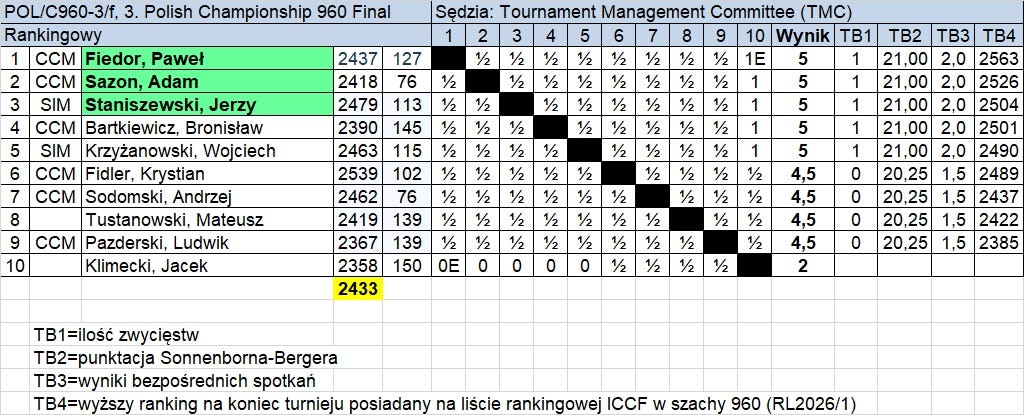
Ten players. Forty-five games. A start date of February 2025 and an end date officially set for June 2026. Each game played under the Triple Block system with 50 days initial time bank and 3 days increment per move — enough time, in theory, to find the truth in any position. In practice, enough time to find the truth and still not separate five players who finished level on every meaningful measure.
When the dust settled, five of us had scored 5 points from 9 games. One win each. Sonneborn-Berger: 21 points apiece. Direct encounters: inconclusive. The tournament rules, written in Polish and English on the ICCF server, were unambiguous about the final tiebreaker: wyższy ranking na koniec turnieju — higher rating at the end of the tournament on the ICCF Fischer Random list.
I, rated 2563, took first. Adam Sazon, with 2526, finished second. Three players behind us — Jerzy Staniszewski, Bronisław Bartkiewicz, and Wojciech Krzyżanowski — completed the five-way tie, separated from each other by the same merciless decimal places.
This is the reality of high-level correspondence chess in the mid-2020s. In an era of engine-assisted play, where both players have access to the same analytical tools, decisive results have become increasingly rare. The draws accumulate. The tiebreakers sharpen. A championship can be decided not by the quality of your chess over eighteen months but by a rating figure calculated from results elsewhere.
It is, in a word, unsatisfying — and it is worth being honest about that.
And yet.
The one game I won in this tournament was not a gift. It was not a blunder by my opponent, not a time forfeit (well, technically it was, keep reading), not a fortunate oversight in a balanced position. It was a long, difficult, technically demanding game that required navigating genuine complexity over many moves and many weeks. The win did not feel like luck at the time. Looking back at it now, it still does not.
That game is what this piece is about.
The game
My opponent was Jacek Klimecki, rated 2358 — the lowest-rated player in the field, but as the final standings showed, ratings in correspondence chess tell only part of the story. Every game in this tournament was played with full engine assistance. Rating differences narrow when both players have access to the same analytical tools.
The starting position was Chess960 #761. What matters for our purposes is that neither player had any opening theory to lean on. In Chess960, the pieces are randomised behind the pawns, and with randomisation comes a particular kind of equality: both players must think from move one.
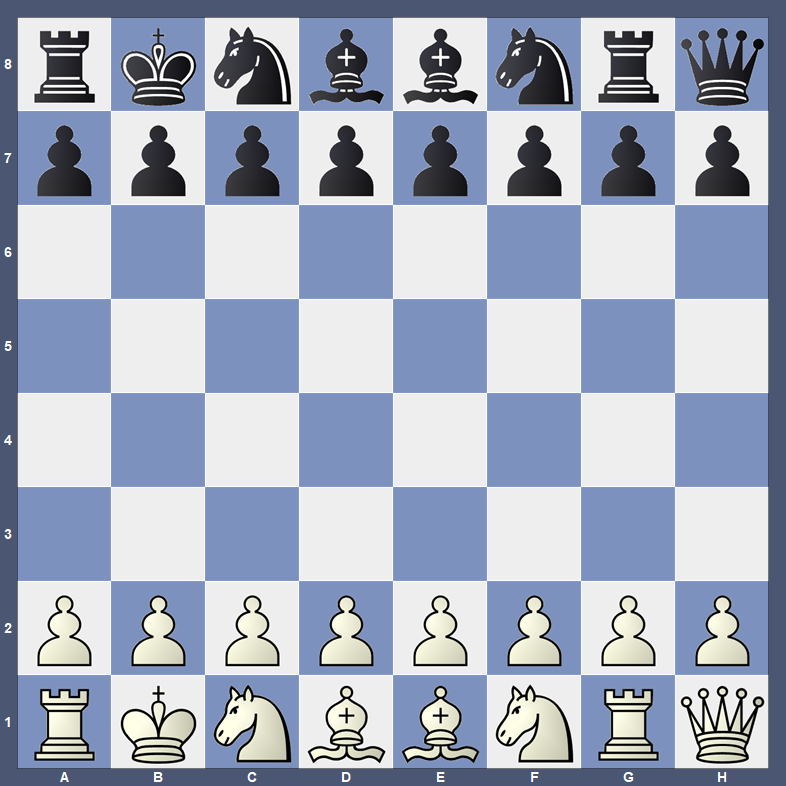
The opening: engines uncertain, humans navigating
The first eleven moves were, by correspondence chess standards, relatively conventional — both sides developing sensibly, staking out central space, probing for weaknesses without committing to anything irreversible.
1.e4 a5 2.a4 d6 3.Ne3 e6 4.h4 Nb6 5.c3 h5 6.g3 g6 7.f4 f5 8.Bf3 c6 9.d4 e5 10.dxe5 dxe5 11.Nd3 Nfd7
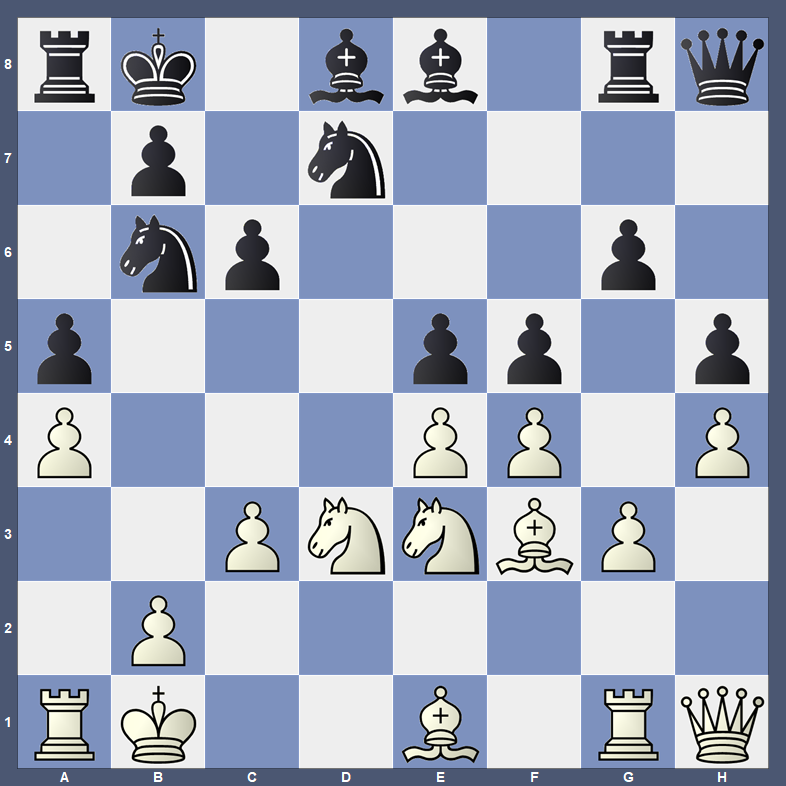
This is one of the genuinely interesting features of correspondence Chess960 at the highest level. After eleven moves, Stockfish 18 — one of the strongest engines in existence — evaluates the position at exactly 0.00. A draw, somewhere in there. The engine sees several reasonable continuations for White: 12.Bd1, 12.Bf2, maybe even 12.exf5 all maintain equality. The position is balanced, complex, and theoretically unexplored.

What my opponent played was 12.Kc2.
Move 12: where the hunt begins
12.Kc2 is probably still a draw with precise play. Stockfish 18 evaluates it at approximately -0.55 — a solid positional advantage for Black, but nowhere near winning. No tactics. No blunders. Just a slightly uncomfortable structure for White that will require accurate defence over many moves to hold.
In over-the-board chess, -0.55 is often nothing. Players at all levels hold positions with that kind of deficit every day. The clock runs, opportunities pass, the game simplifies to a draw.
In correspondence chess, -0.55 is an invitation.
With fifty days per move and engine assistance on both sides, a persistent structural advantage does not evaporate. It must be defended, move by move, over weeks and months, against an opponent who has all the time in the world to find the best continuation. The question is not whether the advantage exists — the engine confirms it does — but whether it can be converted. That is still a human question. And it is where the game became interesting.
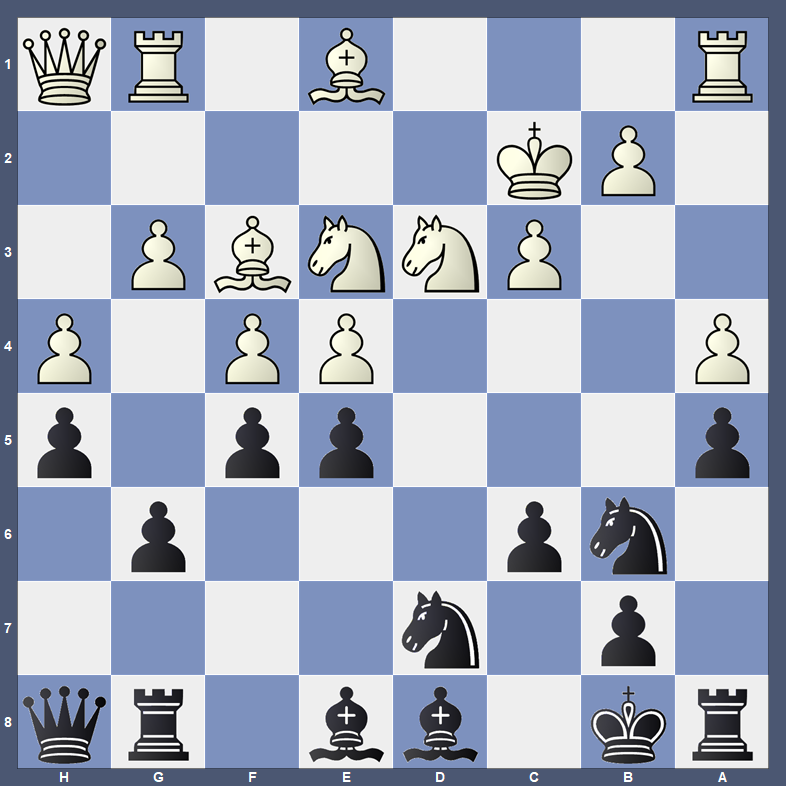
The hunt begins.
Move 15: the second mistake, and what -1.00 actually means
Play continued 12...Bf7 13.Bf2 fxe4 14.Bxe4 Bc7.
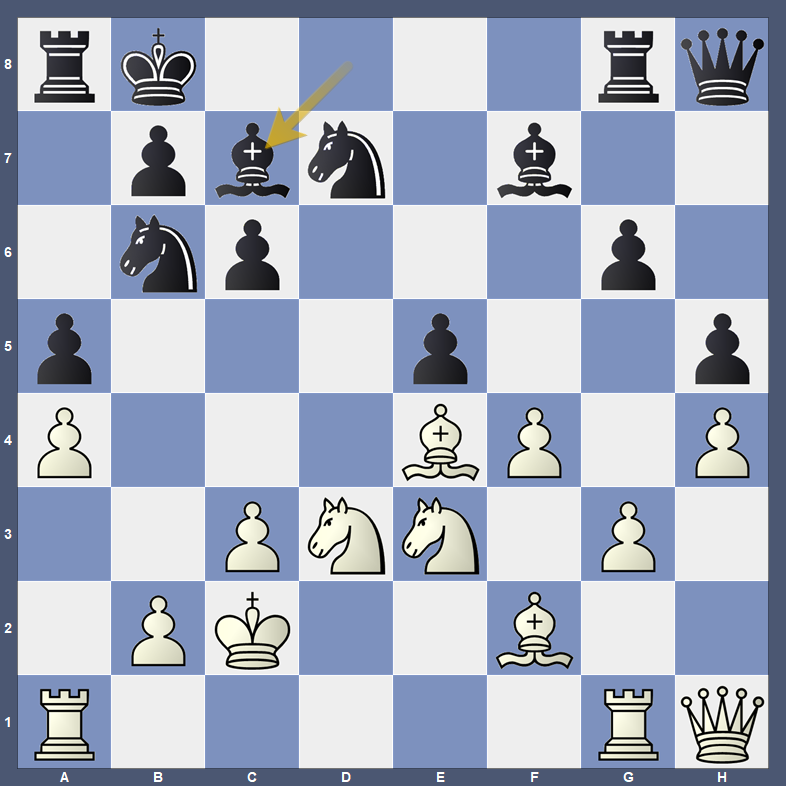
White has a decision to make. The engine is unambiguous about what is required: 15.Nf1, heading for d2 via a regrouping manoeuvre — slow, patient, defensive. The knight on f1 eyes d2, stabilising the position and preparing to challenge Black’s growing initiative. It is not an exciting move. It is a necessary one.
The evaluation after 15.Nf1 remains approximately -0.55. The position is still holdable. The task is difficult but not impossible.
My opponent played 15.b3.
Stockfish 18 evaluates the position after 15.b3 at -1.00.
This number requires explanation, because in correspondence chess it means something specific and significant.
In the standardised Stockfish scoring system, -1.00 represents the point at which the engine would win approximately half of its games against another instance of itself from that position. Not all of them — the position is not lost by force, there is no immediate combination, no tactical refutation. But the structural and dynamic factors have accumulated to the point where, with best play on both sides, Black converts more often than not even against perfect opposition.
In over-the-board chess, two players at human speed might well draw from -1.00 many times. Fatigue, time pressure, and the sheer difficulty of finding the best continuation across dozens of moves all work in the defender’s favour.
In correspondence chess, they do not. With fifty days per move and an engine running on both sides, -1.00 is close to a verdict. Not certain — the game is not won in any obvious way, and a great deal of manoeuvring remains. But the margin for error has narrowed to a point where White must play with near-perfection for many moves in a row, while I need only maintain the pressure and wait.
Two significant inaccuracies in a correspondence game — 12.Kc2 and now 15.b3 — is too much to hope to escape from. The question is no longer whether Black has an advantage. The question is how to convert it.
That process would take another fifty moves.
Move 30: where engines go quiet and humans must decide
The middlegame that followed was exactly what -1.00 promises and nothing more — a long, grinding process of tightening the position, preventing counterplay, and steering towards an endgame where Black’s structural advantages could be expressed. Neither dramatic nor obvious. The kind of chess that correspondence play is built for.
After 30.Kxc3, the engine fell silent in a different way.
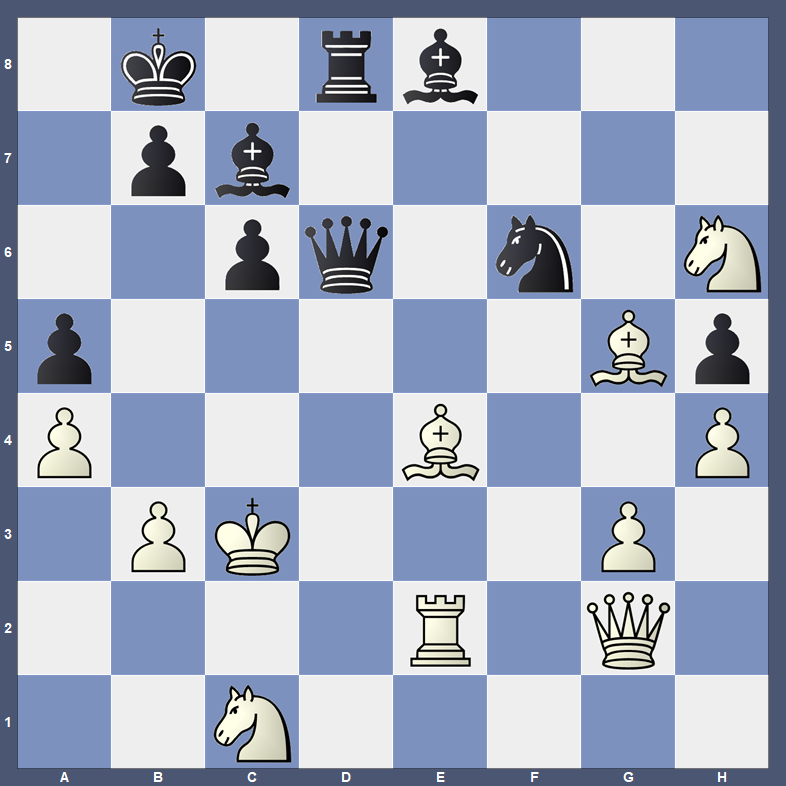
Two moves present themselves for Black. 30...Qc5+ and 30...Qd4+. Stockfish 18 evaluates both at approximately the same figure — the distinction between them, in terms of raw centipawns, is negligible. The engine sees equivalent winning chances in either direction and declines to express a strong preference.
This is the moment in correspondence chess that no engine can resolve for you.
Both moves lead, with best play from both sides, to an endgame featuring two bishops against two knights. The material is roughly balanced. The question is which version of that endgame — which pawn structure, which king position, which specific configuration of pieces — gives Black the better practical chances. Not better in theory, necessarily. Better in practice, against this opponent, from this position, in this tournament.
I spent a considerable amount of time here. Not calculating — the engine handles calculation. Thinking. Going deep into the lines, tracing where my opponent might find rescue, where he might face a harder choice, where a mistake was more likely to appear. Both paths seemed to lead to the same general destination, but the roads themselves were different.
In the end I played 30...Qc5+.
I will not pretend it was a purely analytical decision. The lines were close enough that something else entered — call it intuition, or pattern recognition, or simply a judgment about which type of endgame I understood better. 30...Qd4+ was equally valid. I chose Qc5+ because the positions it produced felt, to me, more concrete. More navigable. More likely to offer a moment of clarity in the endgame to come.
Is two bishops against two knights winning in theory? The bishops are more mobile across an open board — that much is well established. But who can know for sure in this specific configuration, with these specific pawns, at this specific stage of the game. The engine offers a number. The conversion remains a human problem.
What followed was fifty more moves of technical endgame chess — the kind that correspondence play was invented for, and the kind that almost no other format of the game could produce.
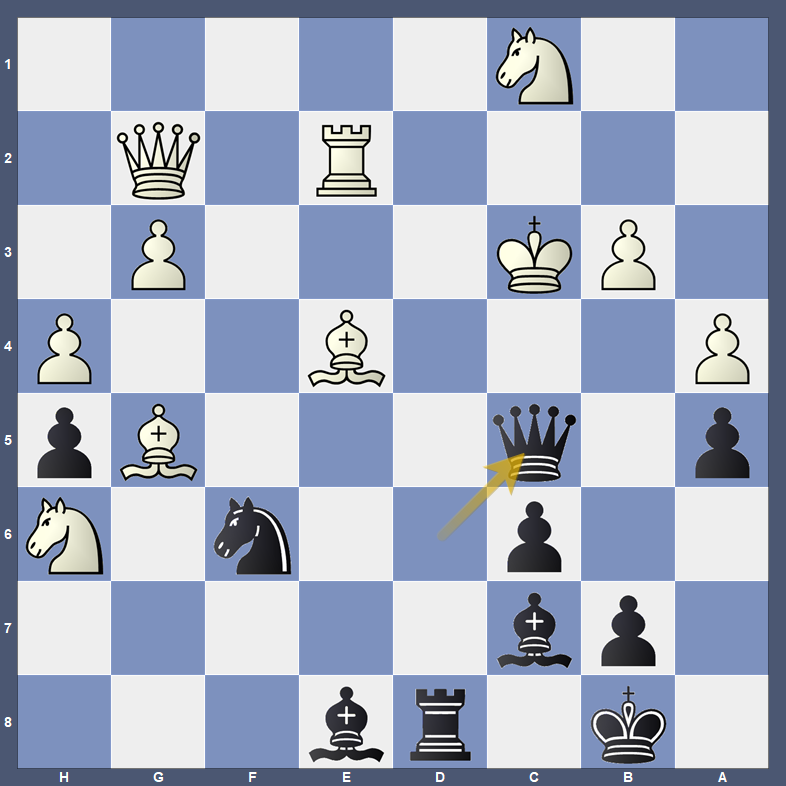
The endgame: a dark forest with one way out
After 36...Bxd8 the queens and rooks were gone. What remained was the endgame I had been steering towards since move 30 — two bishops against two knights, with pawns on both sides of the board.
This is where correspondence chess earns its reputation for brutality. Not the tactical brutality of combinations and sacrifices, but the slow, methodical brutality of technique. An endgame that a computer evaluates as winning in principle must still be converted move by move, over weeks, against an opponent who has the same engine and the same amount of time.
My approach had two components.
The first was practical: I was watching the clock. In correspondence chess, time pressure is a slow accumulation — not seconds but days, draining from a bank that started at fifty and does not refill quickly. Keeping the position complex, forcing my opponent to spend time on difficult decisions, was itself a weapon. A player running low on time makes worse decisions. The pressure is quieter than a ticking clock but no less real.
The second was the dark forest principle. There is a famous observation in chess — attributed, in various forms, to several grandmasters — that the best way to win a game is to lead your opponent into a dark forest where there is only enough of a path for one. In endgame play, this means creating positions of sufficient complexity that the engine’s recommended defence is narrow, non-obvious, and easy to miss under pressure. Not positions where the opponent blunders a piece. Positions where the correct move looks wrong, and the wrong move looks natural.
There were several of those traps in the endgame that followed. Most were escaped — my opponent defended well, and I do not want to suggest the win was straightforward. It was not.
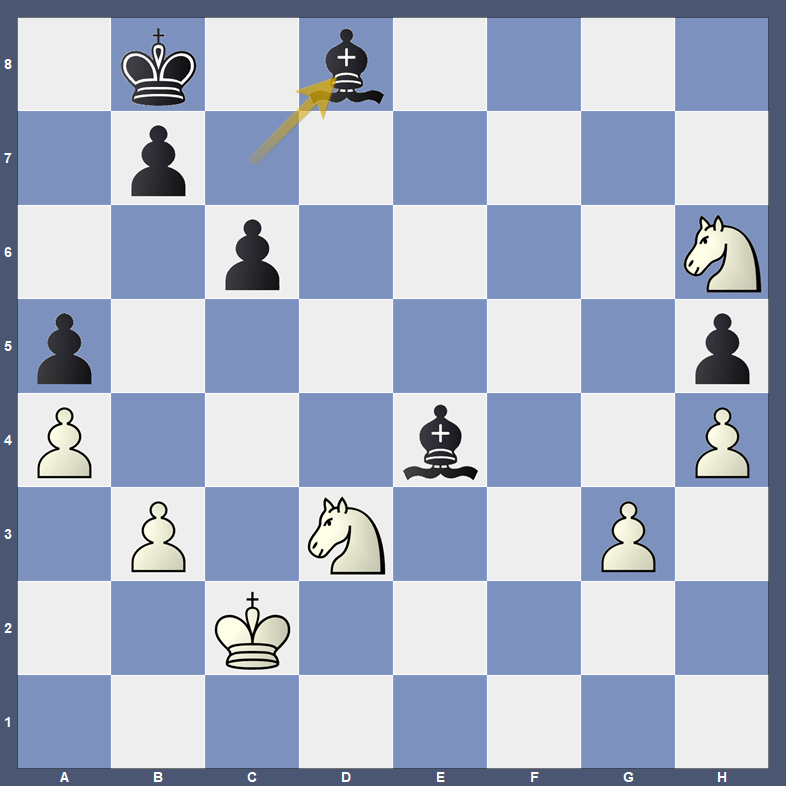
The final trap arrived after 59...Ba7+.
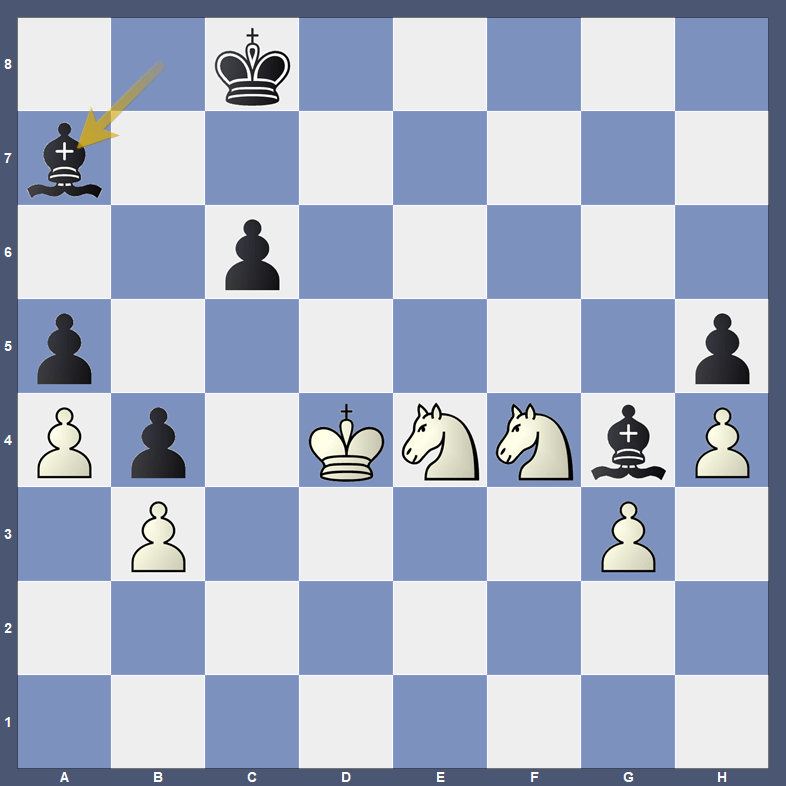
White has two king moves. 60.Kc4 is the only way to hold — a counter-intuitive retreat that keeps the king active and prevents Black’s king from entering the kingside. 60.Kd3 looks natural, centralising the king, but it allows my king to infiltrate via the kingside pawns, and from there the position collapses.
My opponent played 60.Kd3.
The rest, as they say, is history. My king advanced, the pawns fell, and the position became objectively lost. The game was eventually decided on time — my opponent’s clock ran out before the position reached its logical conclusion — but there was no rescue available regardless. The forest had only one path out, and White had taken the wrong one.
A note on opponents and what comes next
I want to be clear about something before closing.
Jacek Klimecki played well. All of my opponents in this tournament played well. The five-way tie on 5 points, decided by rating in the final tiebreaker, reflects the extraordinary quality of the field and the difficulty of the format. In Chess960 correspondence chess at the national championship level, decisive results are earned, not given.
The championship itself was a prelude. This year, the 4th Polish Chess960 Championship will be held — an international tournament, open to players beyond Poland, organised to commemorate the 100th anniversary of the Polish Chess Federation. It is a significant event, and one that attracted the strongest correspondence Chess960 players from across the ICCF world.
To my opponents in the 3rd championship, and to those who will compete in the 4th: amici sumus.
We are friends. The game is the thing.
Full game score:
Chess960 Position #761
White: Klimecki, Jacek (2358) — Black: Fiedor, Paweł (2437)
3rd Polish Chess960 Championship Final (POL/C960-3/f)
Result: 0-1 (65 moves)

1.e4 a5 2.a4 d6 3.Ne3 e6 4.h4 Nb6 5.c3 h5 6.g3 g6 7.f4 f5 8.Bf3 c6 9.d4 e5 10.dxe5 dxe5 11.Nd3 Nfd7 12.Kc2 Bf7 13.Bf2 fxe4 14.Bxe4 Bc7 15.b3 O-O-O 16.Rge1 Rge8 17.Rad1 Kb8 18.Qg2 Qf8 19.Kb2 Qe7 20.f5 gxf5 21.Nxf5 Qe6 22.Nc1 Rg8 23.Re2 Nf6 24.Rxd8+ Rxd8 25.Nh6 Be8 26.Bf5 Qd6 27.Be3 Nbd5
28.Bg5 e4 29.Bxe4 Nxc3 30.Kxc3 Qc5+ 31.Kb2 Qd4+ 32.Kc2 Nxe4 33.Qxe4 Qxe4+ 34.Rxe4 Bg6 35.Bxd8 Bxe4+ 36.Nd3 Bxd8 37.Kd2 Bd5 38.Kc2 Bf6 39.Nf4 Bf3 40.Nf7 b5 41.Kd2 b4 42.Ng5 Bg4 43.Ne4 Bd4 44.Kd3 Be5 45.Ng6 Bc7 46.Nf4 Kc8 47.Kd4 Bb6+ 48.Kd3 Bd1 49.Kc4 Bd8 50.Nf2 Bc2 51.N2d3 Bd1 52.Nf2 Bf3 53.Kd3 Bb6 54.Ne4 Bd1 55.Kc4 Bc7 56.Nd2 Bb8 57.Ne4 Bf3 58.Kd3 Bg4 59.Kd4 Ba7+ 60.Kd3 Bd1 61.Kc4 Kd7 62.Nf6+ Ke7 63.N6xh5 Kf7 64.g4 Bxg4 65.Ng3 Bf2 0-1
Engine evaluations thanks to Chessify.