



Start with the Marshall Attack, because it is the clearest case of what these players are fleeing.
Across 2015–2023, 72% of correspondence games between players both rated above 2400 that reached the Marshall — 336 of 464 — got to move 20 without either side playing a move that had not appeared in an earlier game in the database. The median such game does not diverge from the record until deep in the twenties. The Marshall in correspondence has become a recital: a drawing mechanism whose main lines are mapped, engine-checked, and available to both players before the first move. To enter it is to agree to play twenty moves of other people’s chess.
Openings like that are what this piece is about — and, more precisely, what the elite repertoire does to avoid them. There is a common story about the engine era in which opening theory gradually fills up until the game is solved from the first move. The correspondence data tell a stranger story. Theory is filling up. But at the top, the games are staying ahead of it, and the way that happens is visible in the numbers.
One scoping point governs everything after. What I measure is the move at which a game departs from the public correspondence record — the 1.56 million prior rated games in this corpus. That is not where the players stopped relying on preparation; they prepare from engines, from over-the-board games, from private files that never reach a rated game. A move new to this database at move 14 is often not new to the two players. So this is a repetition rate for the shared correspondence book, not a measure of how much chess has been solved. Every figure is a floor.
The flat line that wasn’t
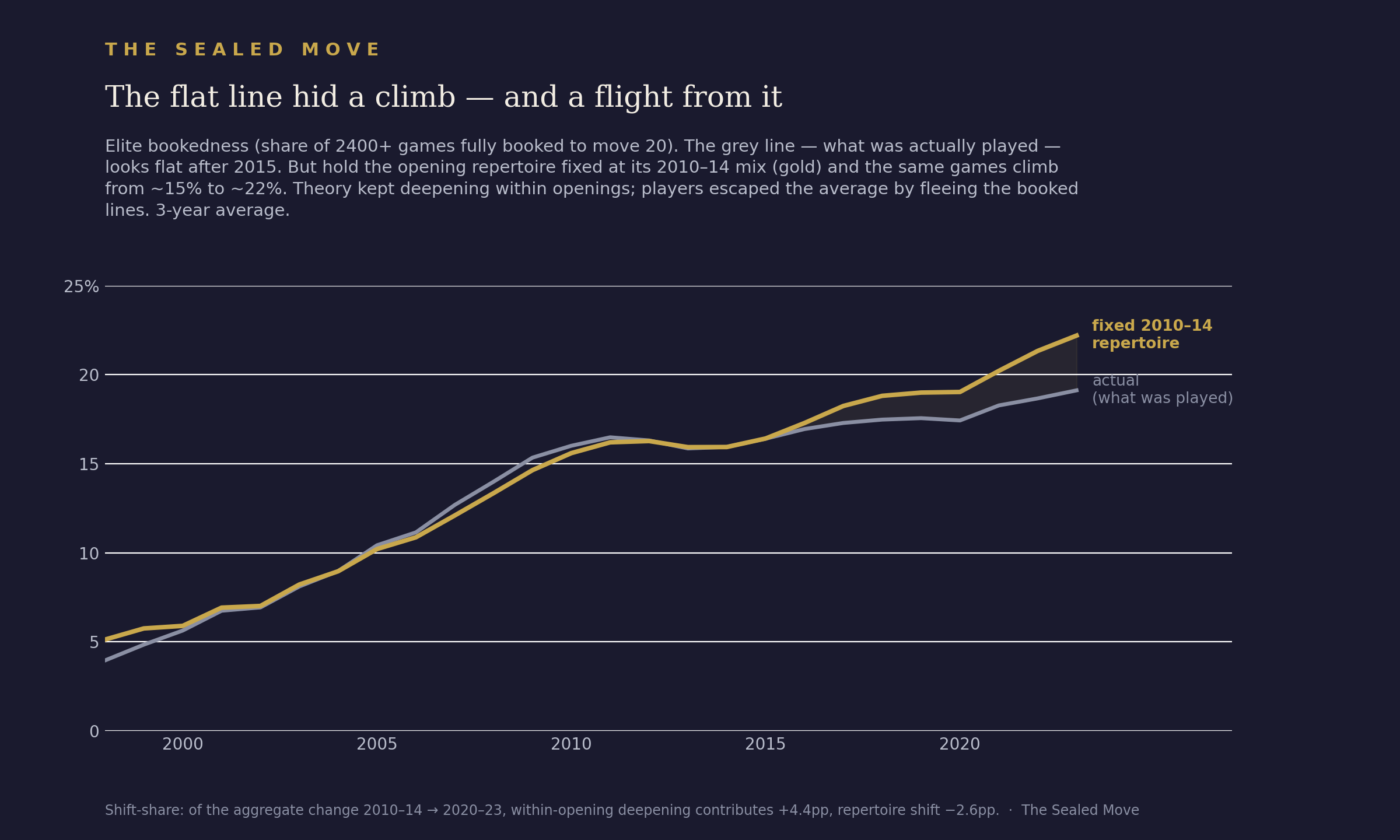
Take the obvious measure first: the share of elite games that reach move 20 with no new move, year by year. Plot it and you get something that looks like a plateau. For players both above 2400, the share climbed from around 2% in the late 1990s to roughly 17% by the mid-2010s — and then, from 2015 to 2023, it holds near 17%, barely moving. The genuine top of the game, players both above 2500, shows the same shape one notch lower, flat near 14%.
For a while I believed that flat stretch was the finding: theory approaching saturation, the book filling until it could fill no faster. It is not. The flatness is an average concealing two large and opposite movements — theory deepening within openings, and the repertoire shifting toward the openings where it deepened least — and separating them is the actual story.
Hold the opening repertoire fixed — freeze each opening’s share of elite games at its 2010–2014 level, then apply the bookedness each opening actually had in later years. The flat line comes apart. On a fixed repertoire, elite bookedness does not plateau after 2015; it climbs from about 15% to about 22%. Theory kept deepening inside the openings. What flattened the aggregate was that the elite repertoire moved toward the openings where it was deepening least.
The decomposition is clean, and it points the other way from the naive reading. Of the aggregate change from 2010–2014 to 2020–2023, deepening within openings contributes +4.4 percentage points; the shift between openings contributes −2.6. The two nearly cancel, and their near-cancellation is the flat line. The within figure is an upper bound — the openings players kept are, by the same logic, selected for slower deepening, so a truly constant repertoire would have deepened somewhat less than +4.4pp — but the direction is not in doubt, and it is robust: the split holds between +4.1/−2.4 and +4.6/−3.0 across base periods and after dropping the smallest openings. Crucially, the deepening is concentrated in the sharp, linear openings, not the flexible ones: the Semi-Slav booked up +12pp, the Grünfeld +14pp, the French +9pp over the decade, while the flexible, transposition-prone systems (English, Réti, Italian) contributed far less to the within-opening rise. Whatever the exact magnitude, the book did not stop filling; the repertoire shifted out from under it.
Where they ran from, and to
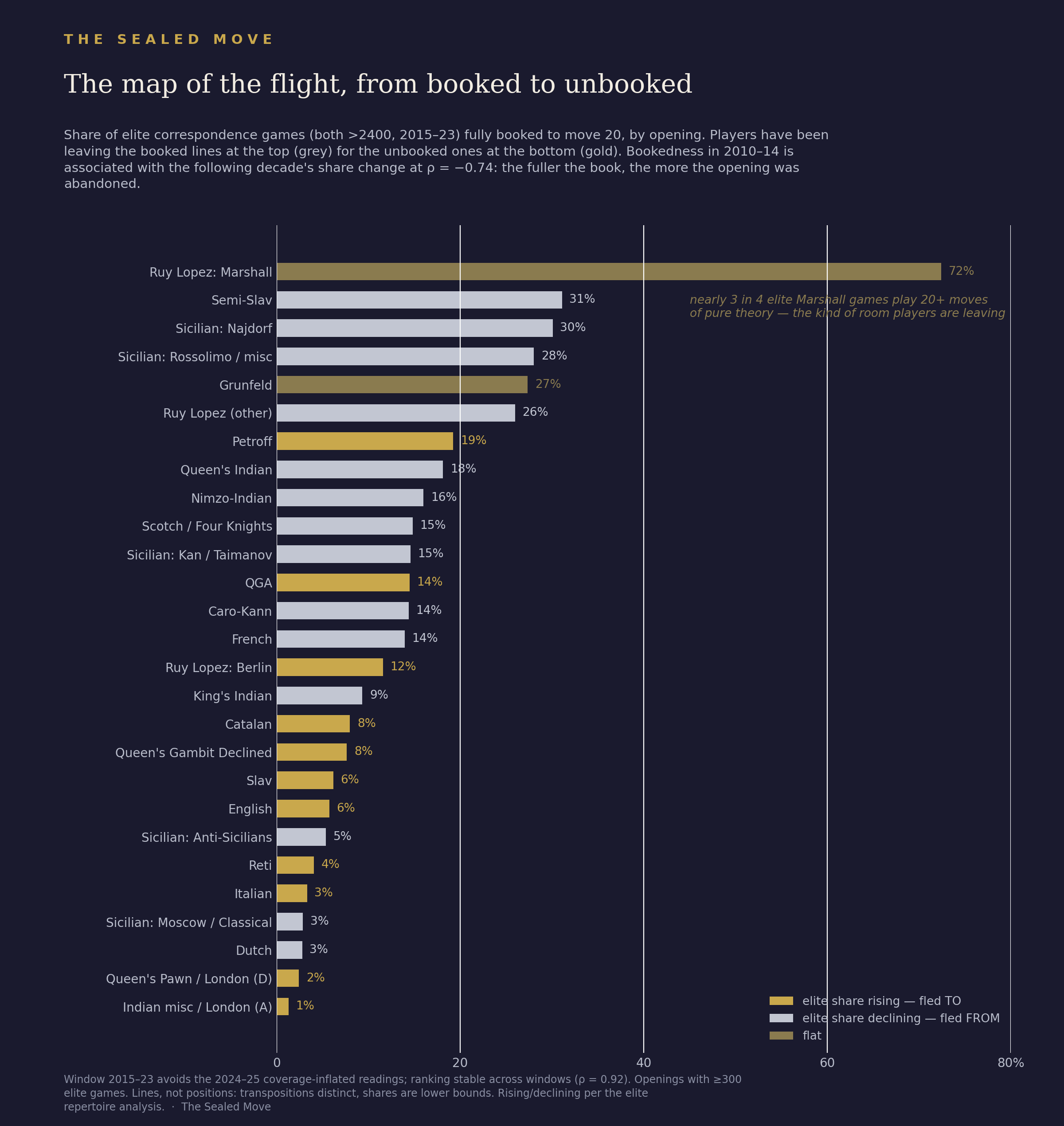
The direction of the flight is exactly what the flat aggregate hides, and it is not random.
Rank the elite openings of 2015–2023 by how booked they are. At the top, the sharp, heavily analysed lines: the Marshall at 72%, the Semi-Slav at 31%, the Najdorf at 30%, the Rossolimo at 28%, the Grünfeld at 27%. At the bottom, the openings where independent play still begins early: the London systems at 1–2%, the Italian at 3%, the Réti at 4%, the English at 6%, the Queen’s Gambit Declined at 8%.
Now set that against the repertoire shifts I documented in the earlier piece on opening popularity. The openings the elite has been shedding are the booked ones. The openings it has adopted are the unbooked ones. The migration runs down this table — out of the Najdorf and Semi-Slav at thirty per cent booked, into the Italian and English at three and six. The players moving to the Italian were not choosing it for its ideas; they were choosing it for its emptiness.
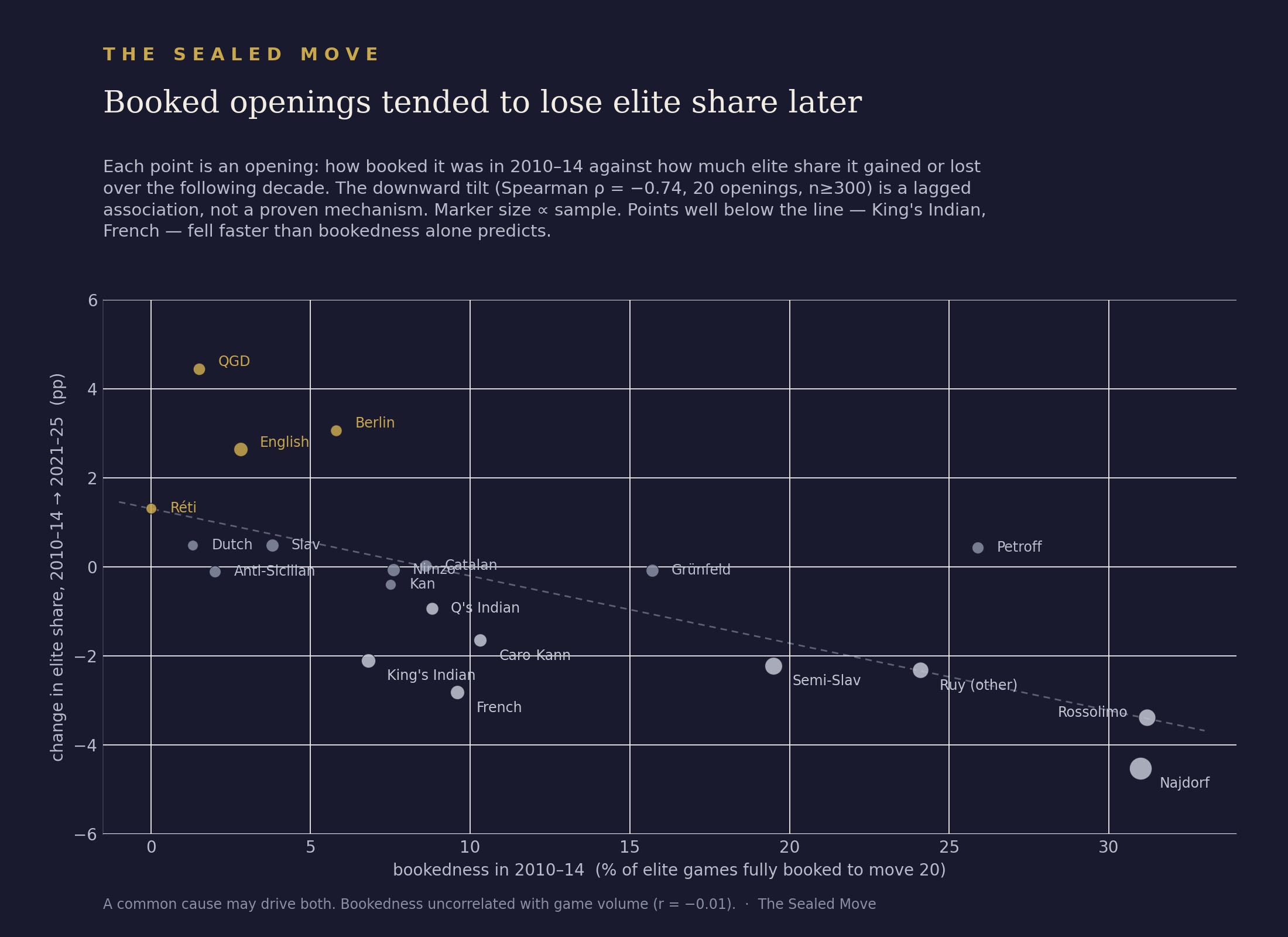
And the migration is not merely contemporaneous with the book closing — it lags it, in the direction cause would run. An opening’s bookedness measured in 2010–2014 is associated with how much elite share it subsequently gained or lost over the following decade, at a rank correlation of −0.74. The openings already heavily booked in the early 2010s are the ones players left afterward. The predictor sits entirely before the migration window, so the relationship owes nothing to the recent data. This is an association, not a proven mechanism — a common cause could drive both, if sharp, narrow lines simply attract early heavy analysis and later abandonment for their own reasons. But the ordering is at least consistent with the book closing first and the players leaving after.
Two ways an opening empties — offered as hypothesis
Look at which openings sit furthest from that trend and a rough split appears. Some lost elite share after becoming heavily booked — the Najdorf, the Semi-Slav — the migration this piece is about, players leaving once the theory was exhausted. Others lost share while barely booked at all: the King’s Indian (about 9% booked) and the French (about 14%) declined despite unmapped territory remaining. These do not fit that story — there was no full book to leave — and I flag them as the exception rather than fold them in: their decline is consistent with the explored fraction having already returned a verdict bad enough that mapping the rest was beside the point.
I want to be exact about the status of this split. It is read off the residuals of a one-factor relationship — a hypothesis, not a result — and the same facts admit a simpler reading with no two mechanisms at all: sharp, narrow openings may attract both early heavy analysis and later abandonment as a single tendency, with no separate “exhaustion” and “verdict” stories needed. Distinguishing these would require bringing engine evaluations of the resulting positions into the model, which this analysis does not do. The Petroff is the case that keeps the question open: heavily booked and yet rising in elite share, because when the booked lines are the safe, near-symmetrical positions elite players want as Black, a closed book is a feature rather than something to flee.
A note before the recent data: I stop at 2023
The 2024 and 2025 figures break the pattern — the raw 2400+ share jumps to 22–24%. I do not believe that jump reflects a change in play, and the analysis above deliberately ends at 2023. The short version: almost all of the surge is a batch of games in one narrow rating band entering through a database update, not more or deeper chess. It is real enough in the numbers to need explaining and contaminated enough that its size cannot be trusted. The full diagnosis, and an open question I would like readers’ help with, is in the notes.
What is left
The sealed move — the move a correspondence player settles on alone, the act this publication is named for — arrives, in the shared record, later than it used to: around move 14 in the average elite game, past move 20 in the Marshall. But the deepening those numbers understate is not where the top players spend most of their games, because their repertoire has drifted elsewhere on the board — into the Italian, the English, the slow queen’s-pawn systems — where the record still runs out near move 9 and the game is still theirs to make.
That is the shape the numbers take in the engine era, at least in correspondence: within openings, the public book keeps deepening; in aggregate, the elite repertoire drifts toward the openings where it has deepened least. Whether that drift is deliberate strategy, a thousand independent choices that happen to share a direction, or openings simply following the same curve at different stages, the data cannot say. The underlying role of preparation is certainly deeper than this public-record measure can show. What the measure does show is a repertoire in steady motion down the bookedness gradient — the strongest players, game by game, ending up in the openings where the record still runs out early.
SIM Paweł Fiedor - The Sealed Move
Notes on method and open questions
The corpus and the measure. 1.56 million rated correspondence games through May 2026 (Opening Master OM CORR). “Novelty” is the first ply at which a game’s move sequence departs from all earlier-dated games in the corpus (same-date ties by file order; unknown month/day placed mid-year). Move-sequence hashing to a 60-ply cap. Chess960 and games under 15 full moves excluded. Cohorts require both players above the stated rating; “field” is all other rated games. Annual 2400+ samples run 3,854–6,980 in the 2015–2023 window; 2500+ runs 400–1,340.
The shift-share decomposition. Aggregate elite bookedness changed +2.0pp from 2010–2014 to 2020–2023. Decomposing at fixed 2010–2014 opening weights: within-opening deepening +4.4pp, between-opening repertoire shift −2.6pp, interaction +0.2pp. Holding weights at 2010–2014, the annual series rises from ~15% (2013–14) to ~22% (2022–23) rather than holding flat. The near-flat raw aggregate is therefore compositional, not a ceiling on theory. Robustness: the split holds at +4.6/−3.0 (2008–12 base), +4.4/−2.6 (2010–14), +4.1/−2.4 (2012–16), and +4.2/−2.4 after excluding openings with fewer than 500 base-period games — so it is not an artifact of the base period or the small-opening tail. Identification caveat: the +4.4pp within figure is an upper bound. The fixed-weight counterfactual assumes each opening’s bookedness path is independent of whether players kept playing it, which is not credible — players abandon the fastest-deepening openings, so the retained repertoire is selected toward slower deepening, and a genuinely constant repertoire would have deepened by somewhat less. The sign and rough magnitude survive (the deepening is large and concentrated in openings players did keep, such as the Najdorf and Ruy), but the figure should be read as “at most about +4.4pp,” not a point estimate.
Migrating-in vs migrating-out bookedness. The openings gaining elite share are much less booked than those losing it (2015–2023): English 5.7%, QGD 7.7%, Italian 3.3%, London 2.4% — against Najdorf 30.1%, Semi-Slav 31.1%, French 13.9%, King’s Indian 9.3%. The weight shift is thus from high-bookedness to low-bookedness groups, which is what pulls the aggregate down even as each group deepens.
Transposition, and where the deepening lives. A line-based measure reads a known position reached by a new move-order as a false novelty, and the elite has shifted toward transposition-heavy systems (English, Réti, Catalan) — so one might worry the within-opening deepening is a move-order artifact concentrated in those flexible webs. It is not. Splitting the +4.4pp within-component by opening type, the linear, forcing openings (where transposition cannot manufacture novelties) contribute about +2.0pp and the flexible systems only about +0.7pp; the sharpest openings show the largest within-opening rises (Semi-Slav +12pp, Grünfeld +14pp, French +9pp, 2010–14 to 2020–23), while the flexible group deepened far less in absolute terms. So the deepening is driven by openings immune to the transposition bias, not by it. The migration into flexible systems is also modest (8.7% → 11.9% of elite games). The line-based measure biases the level down — figures are floors — but does not create the decomposition.
Over-the-board theory — a two-sided bias. The corpus is correspondence-only. This creates two opposing biases on the recent within-opening series, and I cannot cleanly size either. On one side, correspondence players import over-the-board novelties — increasingly from the neural-network era — and those register as correspondence novelties because they never appeared in a rated correspondence game, which deflates measured bookedness more in the later period. On the other, players may follow well-mapped OTB and engine lines further precisely because those lines are now safer and better analysed, which inflates measured bookedness in recent years. Both channels are present; I have no evidence on their relative magnitude, so I do not claim the true within-opening rise is necessarily steeper than measured — only that the level is a floor and the recent trend carries this unresolved two-sided uncertainty. Testing it would require checking positions against an over-the-board database, which is future work.
Is the raw aggregate “flat”? Regressing raw annual bookedness on year over 2015–2023: 2500+ slope −0.09 pp/yr (p = 0.48); 2400+ slope +0.21 pp/yr (p ≈ 0.05), about +1.9pp across the window. That is not noise to wave away — it matches the +2.0pp aggregate change the decomposition reports. The point is that this slow raw rise is a mirage: it masks a much larger within-opening deepening offset by a flight toward less-booked openings. “Flat vs slightly rising” in the raw series is the wrong question; the real motion is the split beneath it.
The lagged relationship. 2010–2014 bookedness vs 2010–2014 → 2021–2025 share change, 20 opening groups with n ≥ 300, Spearman ρ = −0.74. Leave-one-out holds it between −0.70 and −0.81. Bookedness is uncorrelated with an opening’s raw game count (r = −0.01); ranking stable across windows (ρ = 0.92). Chart title states association, not cause, deliberately.
The Marshall figure. 72.4% on n = 464; adding or removing five booked games moves it about a point (71.3–73.5%).
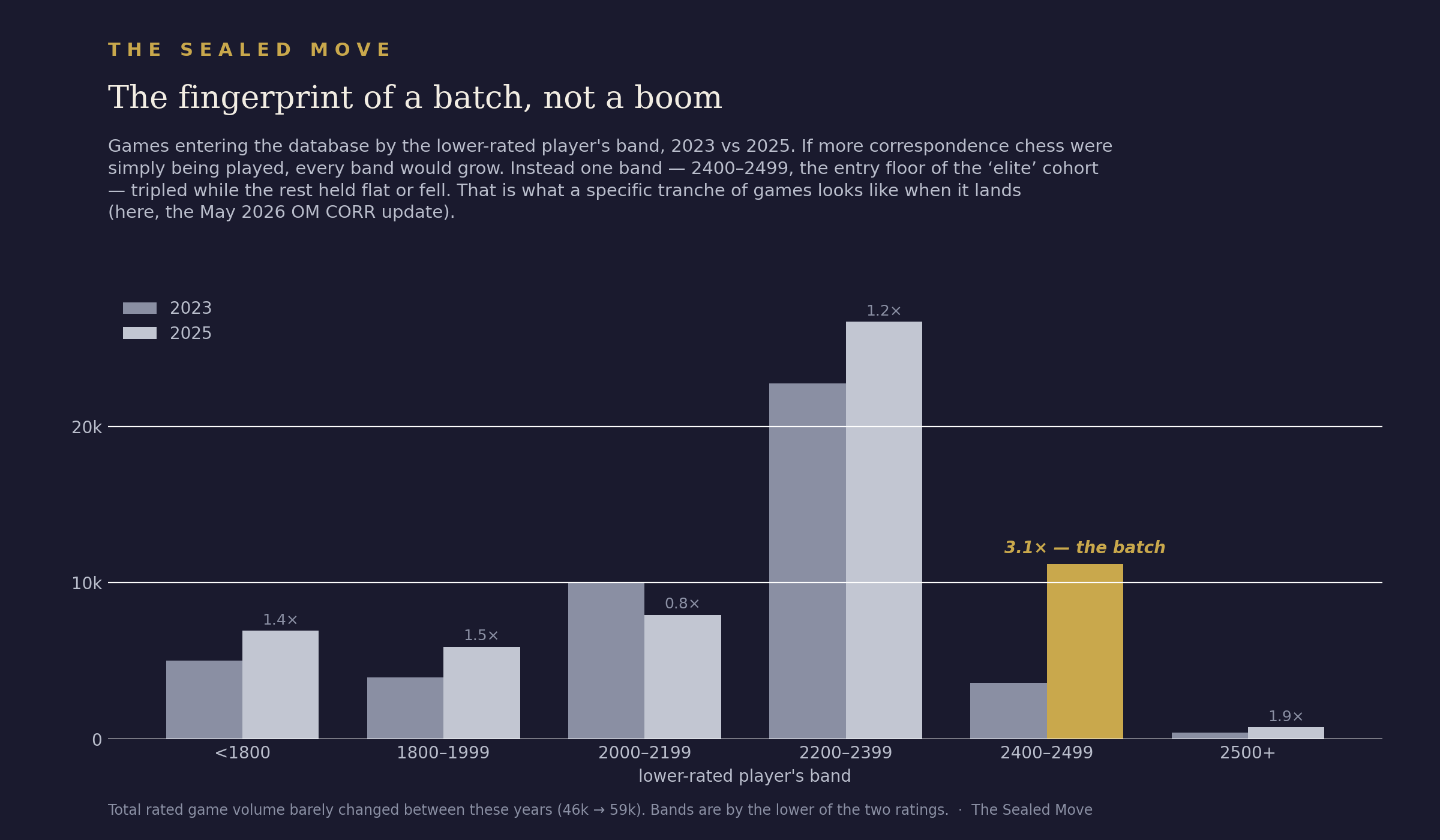
The 2024–25 break — and a question. The recent jump is not spread across correspondence chess. Total rated volume barely moved (about 46,000 games in 2023, 59,000 in 2025). But by the lower-rated player’s band, one slice tripled: games with the lower player in the 2400–2499 band went from about 3,600 to over 11,000, while every other band held flat or fell — one (2000–2199) shrank. That single-band flood is the signature of a batch entering the database, in my case the May 2026 OM CORR, not a change in play; because the elite cohort needs both players above 2400, tripling its entry band reshapes the pool. Two things complicate a clean “ignore it”: the new 2400–2499 games are individually more booked than the same band in 2021 (by about six points), and the 2500+ cohort, which no batch inflated, also rose over the two years (about 14% to 19%). The higher within-band bookedness is consistent with a non-random selection of events or players — for instance a rating-normalisation patch bumping historical, heavily-booked 2350-rated games into the 2400 bracket, a common cause of single-band floods in third-party database updates — but the current metadata do not let me test that. Uniform downsampling cannot settle it: thinning a batch-dominated pool keeps the batch, which is why the band decomposition, not the downsampling, is the honest test. So the open question, for a readership that knows this data: what did the May 2026 OM CORR actually add — which tournament cycle, which server backlog, or which rating adjustment? If you know, you can probably tell me whether the last two years are noise or news.
Great analysis. This has certainly been the case in my games. I think trying to increase decision burden for opponents means moving away from the most heavily booked variations. I think it is a welcome trend also.